Most coloring frustration comes from a mismatch. A three-year-old is handed a page of tiny flowers and scribbles across it. A seven-year-old is handed a giant apple and is bored in a minute. Neither child is bad at coloring. The page was wrong for them.
This guide explains what makes a coloring page easy or hard, what suits each age from two to eight, which tools to pair with it, and how to use the pages so coloring stays fun and builds the hand for writing.
What makes a page easy or hard
Four things decide difficulty:
- Area size. Big areas are easy; small areas need precise wrist and finger control.
- Line thickness. Thick outlines forgive overshoots and give the eye a clear target. Thin lines demand accuracy.
- Number of areas. A page with five areas is a five-minute task. A page with fifty is a half-hour commitment.
- Detail and clutter. Patterns, textures and backgrounds add areas without adding interest for young children.
A page with big areas, thick lines and a few shapes suits a toddler. A page with small areas, thin lines and many shapes suits a seven-year-old. Everything in between is a matter of matching. Our guide to coloring skills by age describes what children can do at each stage.
Ages 2 to 3: big and bold
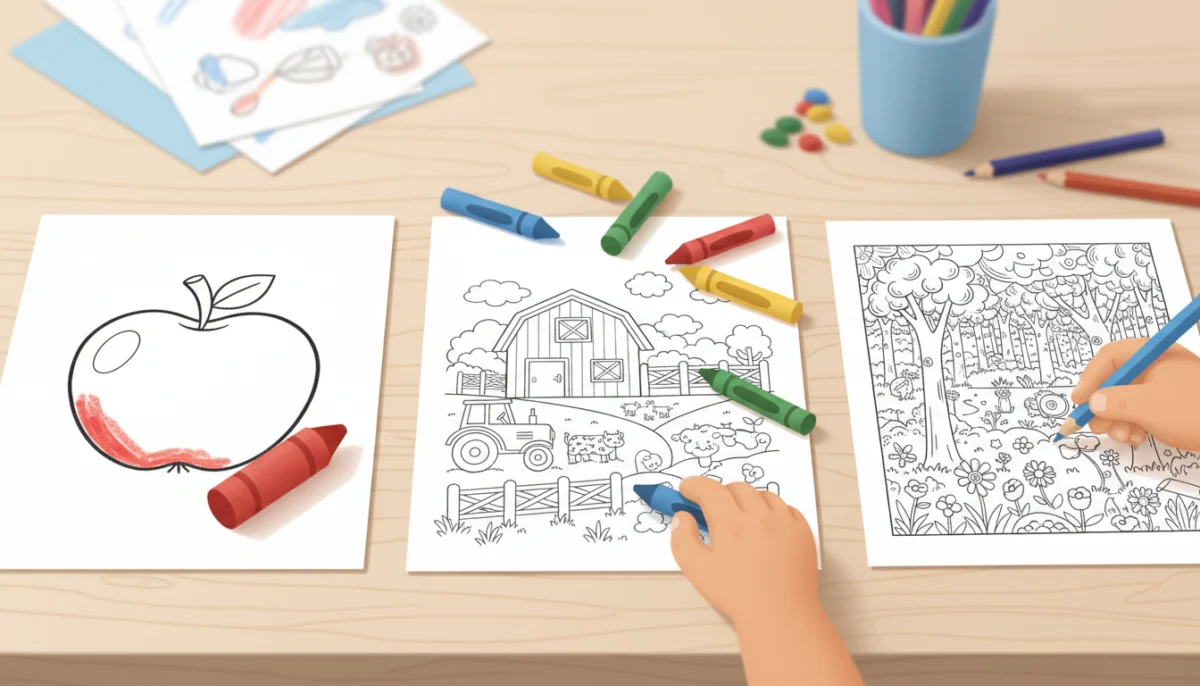
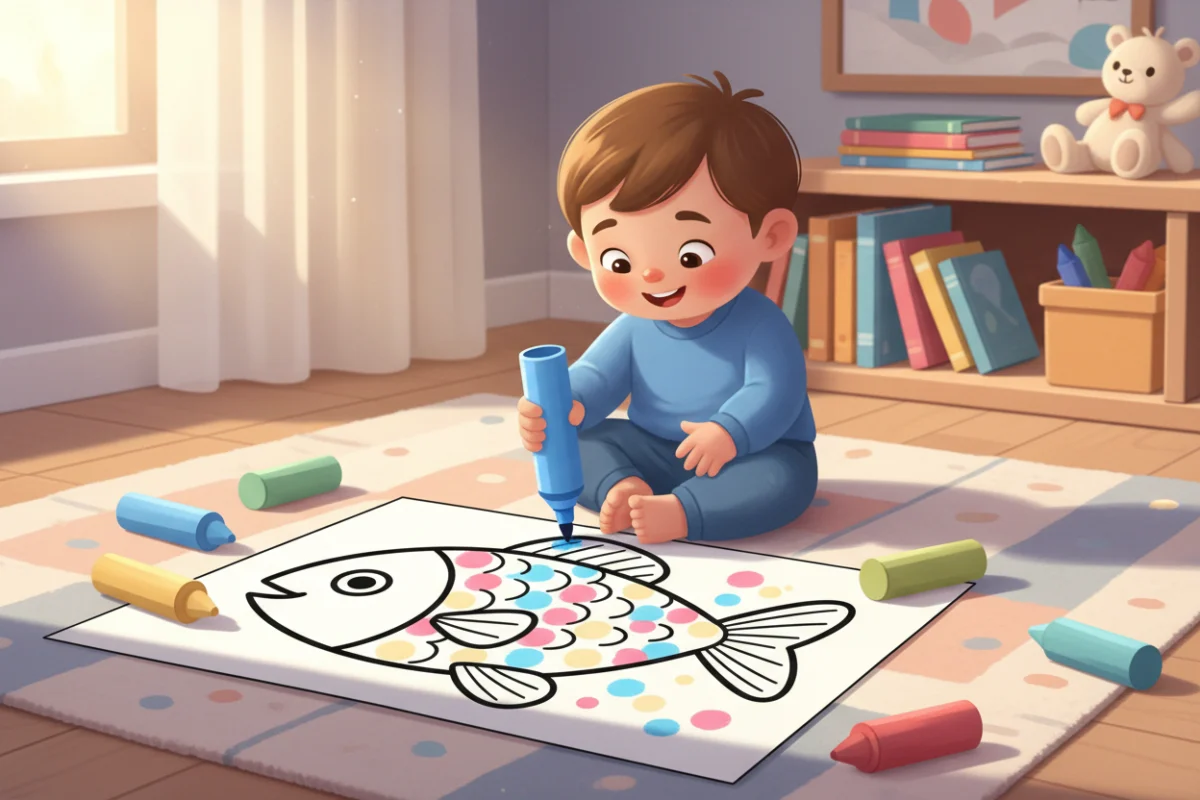
Look for pages with two to five large areas, very thick outlines, and a single clear subject: an apple, a ball, a fish. Even better are giant pages that cover a whole table, where big arm movements land inside the lines. Dot markers and chunky crayons are the right tools. Do not expect the child to stay inside the lines; expect them to notice the shape and put color near it.
Ages 3 to 4: simple scenes
Five to ten areas, thick outlines, a subject the child recognizes and can name. A house with a sun and a tree. A dog with a bone. Avoid backgrounds and patterns. Chunky or triangular crayons help the developing grasp; our guide to helping your child hold a pencil explains why short, fat tools work better. Most children at this age color a large shape mostly inside the lines and stop when the interesting part is done.
Ages 4 to 5: more shapes, still large
Ten to twenty areas, medium-thick outlines, scenes with several elements. A farm with animals. A vehicle with parts. Children at this stage begin to choose colors deliberately and to color in one direction. Regular crayons and washable markers both work. Pages with a few small details next to large areas let the child choose their own challenge.
Ages 5 to 6: detail begins
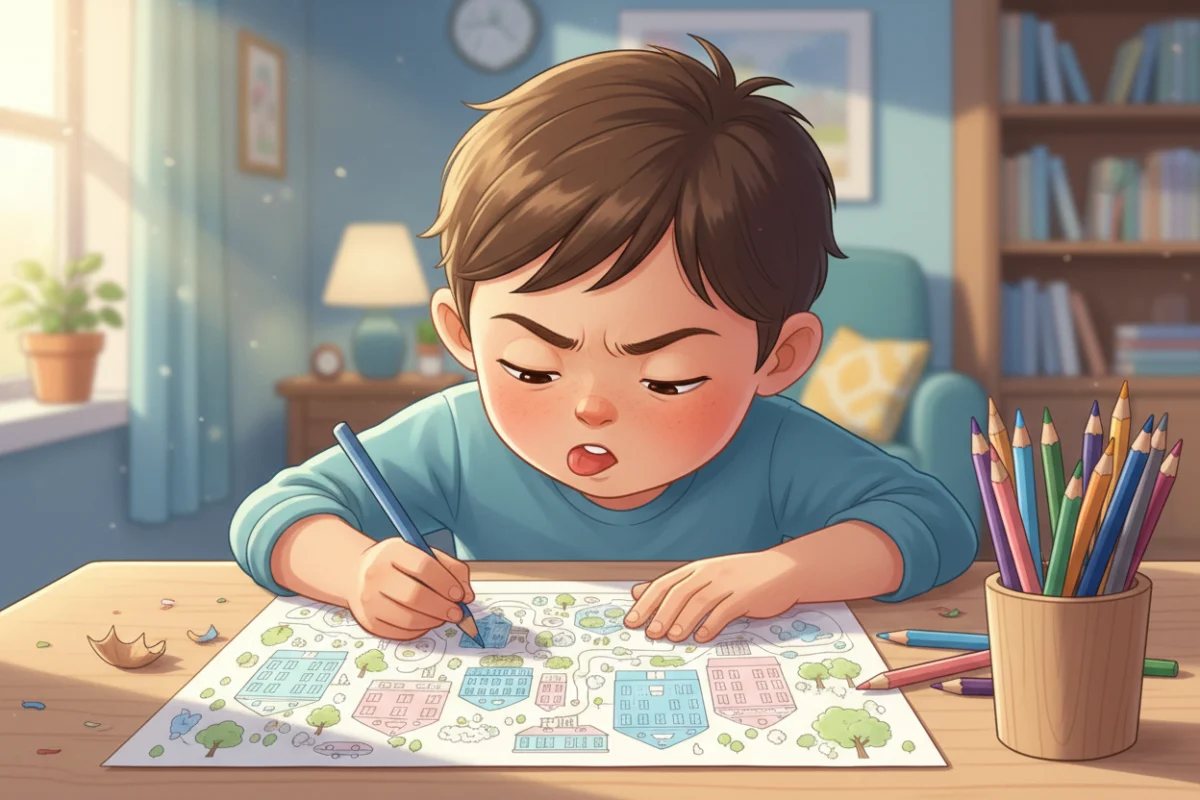
Twenty to forty areas, medium outlines, some small areas mixed with larger ones. Scenes with a story, characters with expressions, seasonal themes. Colored pencils become useful for small areas. Children at this age finish pages, take pride in staying inside the lines, and often want to color the same page again to “do it better.”
Ages 6 to 8: precision and patience
Forty or more areas, thinner lines, patterns and textures. Detailed scenes, mandalas with big central shapes, “color by number” pages. Fine-tip markers, colored pencils and gel pens. Children may color for half an hour or more, shade, and mix colors. This is where coloring most obviously overlaps with the control needed for neat handwriting.
Signs the page is wrong
- Scribbling across the whole page after a few seconds: too many small areas.
- Finishing in a minute and asking for another: too simple.
- Coloring only one big area and abandoning it: too many areas, or not enough interest in the subject.
- Frustration, tearing, pressing hard: areas too small for the child’s control.
- “You do it”: too hard, or the child is tired.
Adjust the page, not the child.
Coloring pages and handwriting
Coloring is one of the best preparations for writing precisely because it looks nothing like writing. A child who colors a medium-sized shape neatly is practicing a stable grasp, even pressure, small wrist and finger movements, and keeping the marks inside a boundary. Those are the same skills that later keep letters on the line and the same size. A child who avoids coloring or cannot yet stay inside a large shape often struggles with early writing for the same reasons, which is why pediatric occupational therapists ask about coloring. Our guide to graphomotor skills explains the connection.
None of this means you should push coloring as handwriting training. Choose the right page, keep it fun, and the skills come along on their own.
A simple test before you print
Hold the page at arm’s length. If you can still see every area clearly, it is probably suitable for a preschooler. If the areas blur into a texture, it is a page for a school-age child. Then look at the biggest area: if it is smaller than your child’s palm, the page is too detailed for a three- or four-year-old. This two-second check prevents most mismatches.
Themes matter as much as difficulty
A page about something your child loves will hold attention twice as long as a generic one. Dinosaurs, vehicles, animals, seasons, holidays, space, the sea, everyday routines. Let your child choose from two or three options. Pages that connect to a book you just read or a place you just visited work especially well.
Tools by age
- Age 2 to 3: dot markers, chunky crayons, broken crayon pieces.
- Age 3 to 4: chunky or triangular crayons, thick washable markers.
- Age 4 to 5: regular crayons, washable markers.
- Age 5 to 6: crayons, markers, colored pencils for details.
- Age 6 to 8: colored pencils, fine-tip markers, gel pens.
Short, fat tools push the fingers into a better grasp. Long, thin tools reward a mature grasp and precise control. Match the tool to the hand.
Ways to use a page beyond coloring it
A well-chosen page can do more than one job. Color it, then cut it out and glue it to a card for a grandparent. Cut a finished page into four or six pieces to make a puzzle. Color the same page on two days and compare. Use a page as a template for a torn paper collage instead of crayons. Or color one area a day as a calm bedtime routine. Each variation extends the life of a page and adds a different fine motor skill to the mix.
Making coloring count
A few minutes of coloring several times a week does more than an hour once a month. Keep a folder of pages at the right level where your child can reach them. Color together sometimes; children copy adult grasp and pressure. And never make a child redo a page. Our fine motor skills checklist by age shows where coloring fits in the bigger picture.
Frequently asked questions
What coloring pages are best for a 3-year-old?
Pages with five to ten large areas, thick outlines and a single recognizable subject, colored with chunky crayons or dot markers. Giant posters are ideal.
At what age can children do detailed coloring pages?
Most children handle pages with many small areas around age six to seven, once they have a mature grasp and can control pressure.
Are printable coloring pages as good as coloring books?
Yes, and often better, because you can pick pages that match your child’s stage and interests instead of a whole book at one level.
How do I know if a coloring page is too hard?
If your child scribbles across it, gives up after one area, presses hard in frustration or asks you to do it, choose a page with bigger areas and fewer of them.