
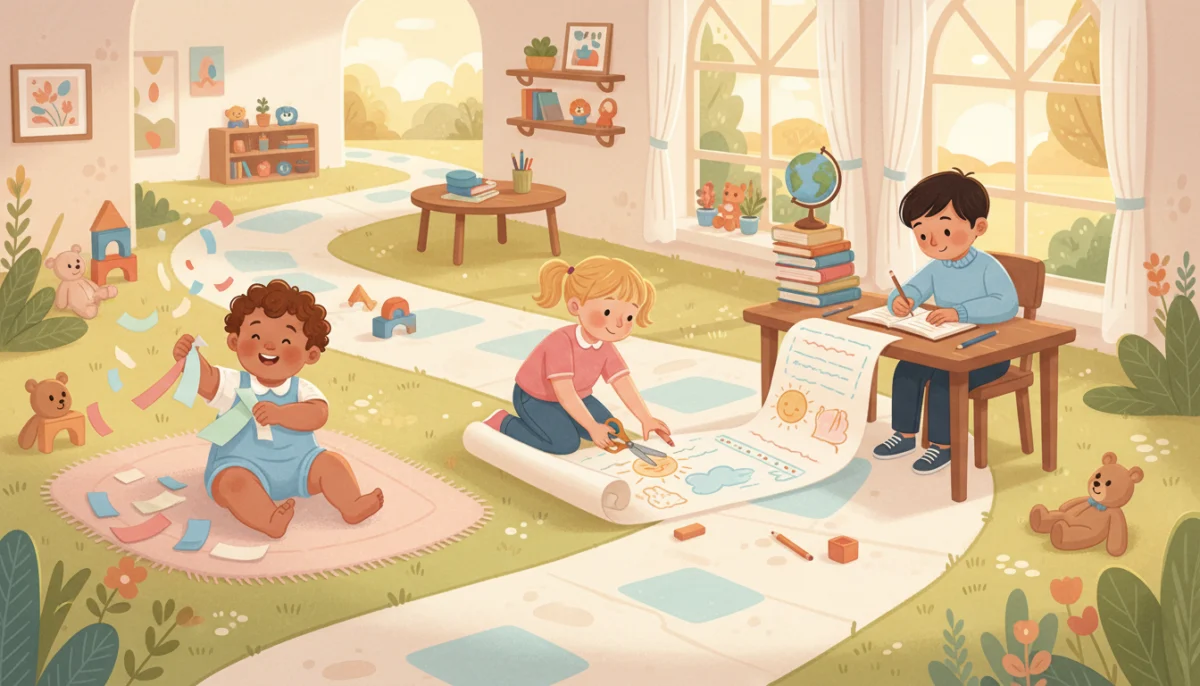
Handwriting does not start with a pencil. It starts years earlier, with tearing paper, squeezing play dough, cutting along a wobbly line and coloring a giant apple. This guide is the map of that journey for children aged three to eight, written for the two groups of adults who walk it with them: teachers in pre-K, kindergarten and the early grades, and parents at the kitchen table.
Every section below links to a full article. Read straight through for the whole picture, or jump to the age or problem in front of you. Each article stands on its own, and together they cover the road from a first fist grasp to fluent, legible writing.
How to use this guide
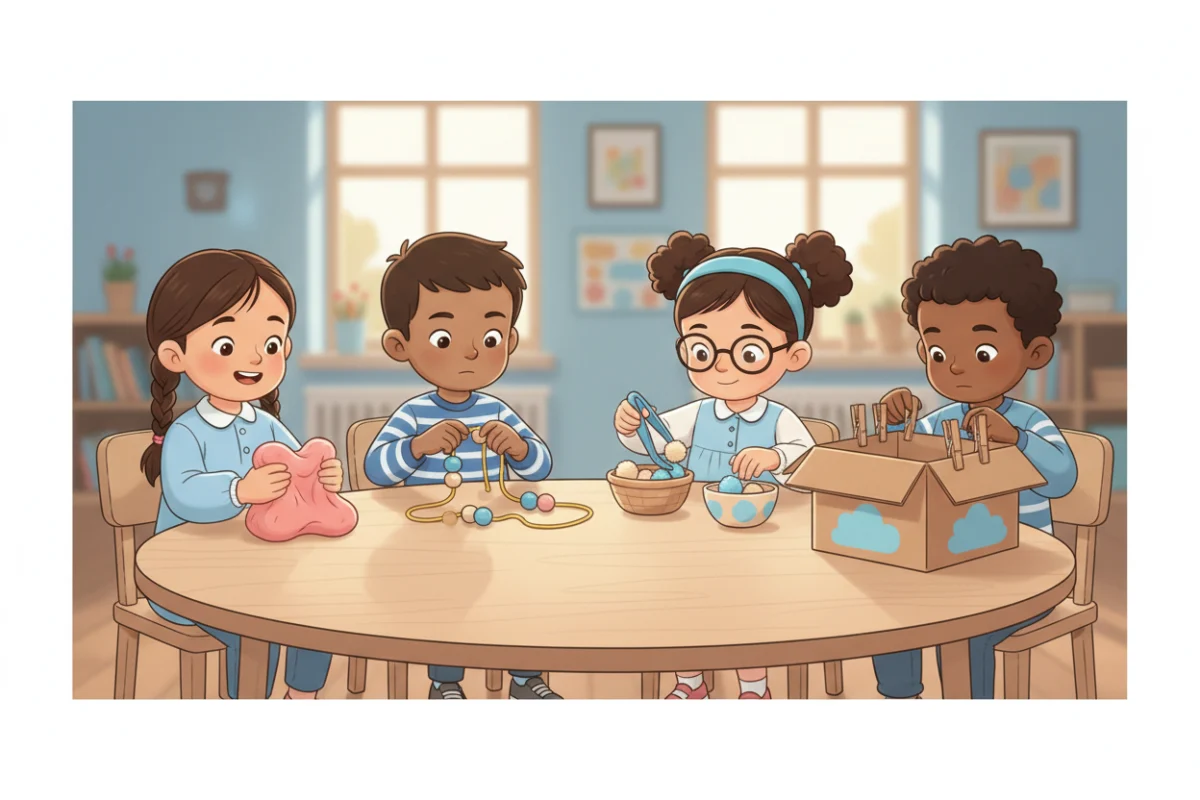
If you are a teacher, start with the foundations and the pre-writing sequence, then dip into the cutting and coloring sections for center ideas. If you are a parent, start with the age checklist and the readiness signs, then pick one or two activities a week. If you have a specific worry, such as a strange pencil grip, reversed letters or a child who hates coloring, the “common problems” section near the end points you straight to the answer.
Part 1: The foundations
Handwriting sits on top of a stack of smaller skills: hand strength, the separation of the two sides of the hand, both hands working together, the ability to reach across the body, and guiding the hand with the eyes. These articles explain the stack and how to build it.
- What Are Graphomotor Skills? A Teacher’s Guide: the starting point. What the term means, how the skills develop from three to seven, and what you can do in an ordinary classroom.
- Fine Motor Skills Checklist by Age (3 to 8): what most children can do with their hands at each age, across self-care, play, drawing, cutting and writing.
- Is My Child Ready to Write? Readiness Signs for Ages 3 to 6: the signs that a child is ready for letters, and what to do if they are not there yet.
- Crossing the Midline: Why It Matters and 10 Games: the quiet foundation behind writing across a page and choosing a dominant hand.
- 15 Fine Motor Activities at Home Using Things You Already Own: the parent’s toolkit for building hands through play.
- 12 Fine Motor Centers That Actually Build Handwriting Readiness: the teacher’s version, organized as classroom centers.
Part 2: The pencil grasp and pressure
How a child holds the pencil, and how hard they press, decide how comfortable and legible their writing will be. These articles cover the normal stages, the red flags and the fixes.
- Pencil Grasp Development: Stages, Red Flags and Classroom Fixes: the stages from fist to tripod, which grasps are functional, and how to nudge a grasp without a battle.
- How to Help Your Child Hold a Pencil Correctly (Without Tears): the same topic for parents, with simple tools and cues.
- Pencil Pressure Problems: Too Hard, Too Light, and How to Fix Both: why some children snap pencil tips and others write invisibly, and what helps each.
- Left-Handed Writers: How to Help at Home and at School: paper position, scissors, and the small adjustments that make a big difference.
Part 3: From strokes to letters
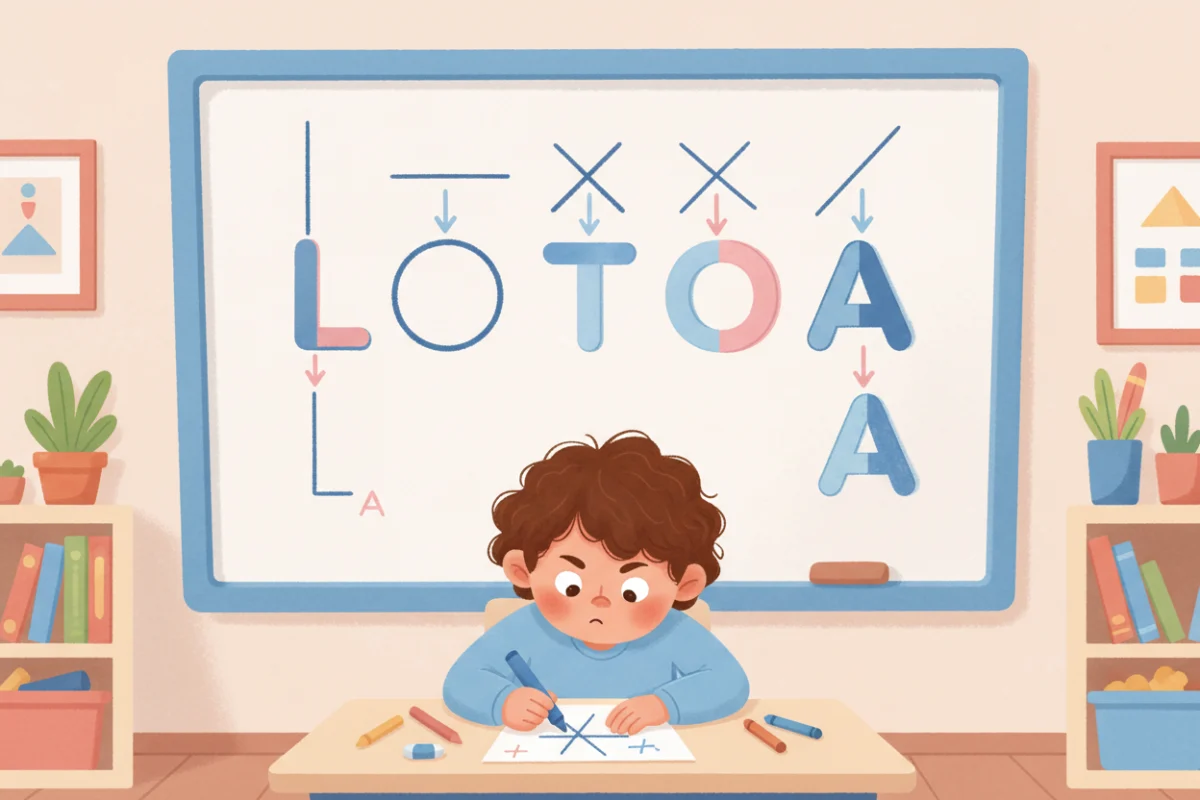
Letters are built from a small set of strokes, and children learn them in a predictable order. These articles lay out that sequence and the teaching methods that prevent the most common problems.
- Pre-Writing Strokes: The Developmental Sequence: vertical, horizontal, circle, cross, square, diagonals, triangle, in the order children can manage them.
- Handwriting Warm-Ups: 5-Minute Routines: shoulder, wrist and finger exercises to open every writing lesson.
- How to Teach Letter Formation: Order, Verbal Cues and Common Mistakes: grouping letters by stroke, consistent cues, and starting at the top.
- Lowercase or Uppercase First? What the Research Says: the case debate settled with a sequence that respects both motor readiness and reading.
- Letter Reversals (b/d, p/q): Why They Happen and How to Fix Them: what is normal, what helps, and the fixes that make it worse.
- Teaching Your Child to Write Their Name: Step by Step: the first word every child wants to write, done in the right order.
- Tracing Worksheets: Do They Actually Work?: when tracing helps, when it backfires, and how to use a printable well.
- Messy Handwriting in First and Second Grade: Causes, Fixes, and When to Ask for Help: for the older child whose writing is still hard to read.
Part 4: Cutting and paper crafts
Scissors use the same fingers as a pencil and train the helper hand that will later hold the page. Paper crafts add tearing, folding, gluing and threading. These articles turn craft time into deliberate fine motor practice.
- Scissor Skills Progression: What to Teach at Ages 3, 4, 5 and 6: the cutting sequence from snips to complex shapes.
- How to Set Up a Cutting Station in Your Classroom: daily, self-directed scissor practice that runs itself.
- Paper Chains, Garlands and Fringe: Cutting Practice That Decorates Your Classroom: a year of variations by skill and season.
- 12 Simple Paper Crafts for Preschool and Kindergarten: each chosen for the skill it builds, with easier and harder versions.
- Fall Leaf and Pumpkin Paper Crafts: ten seasonal crafts in developmental order.
- 10 Easy Paper Crafts for Preschoolers to Make at Home: no special supplies, and your child can actually do them.
- Rainy Day Paper Crafts With Things You Already Have: twelve crafts from the recycling bin, sorted by time and age.
- DIY Photo Booth Props for Kids: cutting practice with a reason to finish.
- Teaching Kids to Use Glue: Sticks, Bottles and Mess-Free Tips: the skill nobody teaches, and how to teach it.
Part 5: Coloring
Coloring is a compact fine motor workout that children choose voluntarily. The trick is matching the page to the child.
- Coloring Skills by Age: What’s Normal at 3, 4, 5 and 6: from scribbles to precision, and when to look closer.
- How to Choose Coloring Pages for Your Child’s Age: area size, line thickness and tools, so coloring stays fun.
- Giant Coloring Posters for Group Work: eight children, one poster, and forty minutes of practice nobody calls work.
Part 6: Seasons and holidays
Every holiday on the school calendar is a fine motor opportunity in disguise: hearts to cut, turkeys to trace, snowflakes to fold, names to write on twenty cards. These articles give teachers a plan for each season and parents a craft list for each holiday, with the skills built along the way.
- Halloween Classroom Activities for Pre-K and Kindergarten (Not Too Spooky): twenty friendly activities and a calm party plan.
- Halloween Paper Crafts to Make With Kids at Home: bats, spiders, pumpkins and friendly ghosts.
- Thanksgiving Classroom Crafts and Gratitude Activities: a gratitude tree, turkeys done well, a class feast and a respectful approach to the history.
- Thanksgiving Crafts for Kids: handprint turkeys, a family gratitude tree and table decorations.
- Winter Holiday Crafts for a Diverse Classroom: snow, light and giving, so every child is included.
- Christmas Paper Crafts for Kids: chains, snowflakes, cards and ornaments.
- 100th Day of School: 30 Activities: collections, 100-piece crafts and fine motor challenges.
- Valentine’s Day Classroom Crafts: heart cutting, card-making as handwriting practice and a low-sugar party.
- St. Patrick’s Day and Spring Crafts for Kids: rainbows, shamrocks, flowers and butterflies.
- Earth Day Crafts Using Recycled Materials: tube animals, box planters and a recycled robot.
Quick paths by age
Ages 3 to 4
Focus on hands, not letters. Read the checklist, play the midline games, do easy paper crafts and coloring with big simple pages, and start snipping. Watch the pre-writing strokes appear on their own.
Ages 4 to 5
Readiness and first letters. Check the readiness signs, work on the pencil grasp, teach the name, and use tracing sparingly. Cutting moves to lines and shapes, and paper chains become a favorite.
Ages 5 to 6
Formal letters. Follow the letter formation sequence, decide on case order, open lessons with warm-ups, and treat reversals as normal. Crafts get more demanding: folding, weaving and threading.
Ages 6 to 8
Fluency and legibility. If writing is messy, start with causes and fixes and check pressure. Detailed coloring pages, props and longer paper projects keep the hands working.
Common problems, and where to look
- A strange pencil grip: grasp stages for teachers, holding a pencil for parents.
- Broken pencil tips or invisible writing: pencil pressure.
- b and d reversed: letter reversals.
- Switches hands, no dominant hand: crossing the midline.
- Cannot use scissors: scissor skills by age.
- Scribbles over every coloring page: choosing coloring pages.
- Glue everywhere: teaching kids to use glue.
- Left-handed and struggling: left-handed writers.
- Writing still messy in second grade: messy handwriting.
- Not sure if it is a problem at all: the checklist.
What comes next
This guide grows as the blog grows. New articles on cutting, coloring, crafts and handwriting are added to the sections above as they are published, so bookmark this page and check back. If there is a question you cannot find an answer to, let us know through the contact page and it may become the next article.
Frequently asked questions
What order should I read these articles in?
Start with the foundations (Part 1), then the grasp (Part 2), then letters (Part 3). The cutting and coloring sections can be read any time, since they support every stage.
Are these articles for teachers or parents?
Both. Each article is written with one audience in mind and tagged “for teachers” or “for parents,” but most apply to either with small adjustments.
What ages does this guide cover?
Three to eight, from the first scribbles and snips through fluent handwriting in second grade.
Is any of this a substitute for occupational therapy?
No. The articles describe typical development and everyday strategies. If a child is well behind across several areas, they point you toward asking a teacher, pediatrician or occupational therapist.