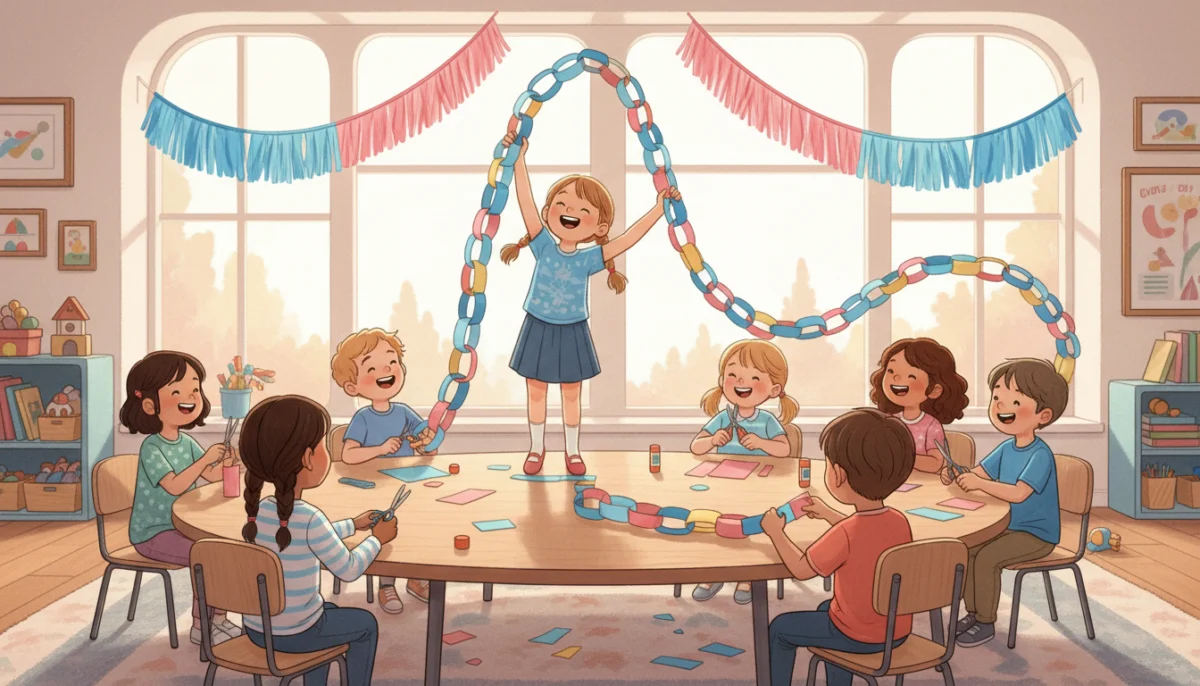
Ask a group of five-year-olds to cut twenty paper strips for practice and you will get groans. Ask them to make a paper chain long enough to reach the door and they will cut fifty. The difference is purpose. A chain, a garland or a streamer is cutting practice with a visible result that goes on the wall, and that makes it one of the most reliable fine motor activities in an early childhood classroom.
This guide covers the basic chain, then a year’s worth of variations organized by skill and season, with the small practical tips that keep the glue off the floor and the chain on the ceiling.
Why chains and garlands work
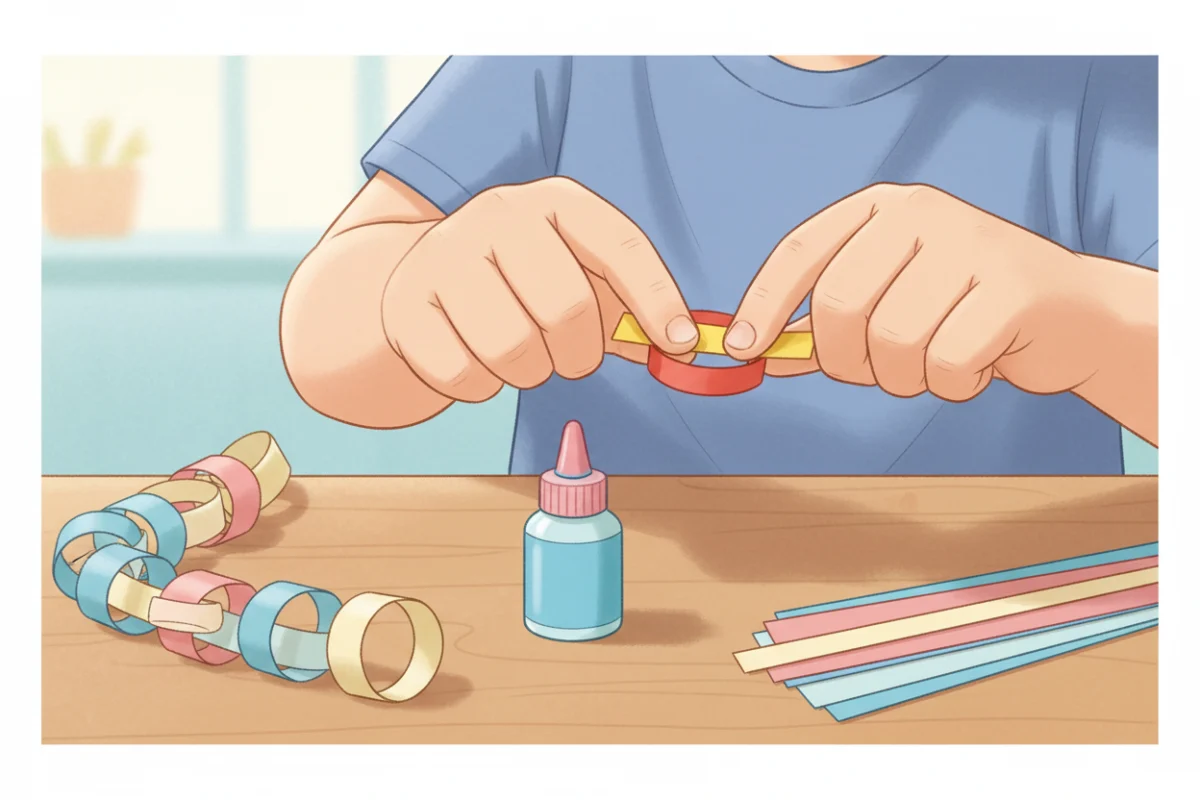
Every loop in a chain involves cutting a strip along a line, curling it, holding it closed with one hand while the other applies glue, and linking it through the previous loop. That is cutting, bilateral coordination, pinch and sequencing in one repeated movement. The repetition is the point: twenty loops is twenty practice rounds, and the child does not experience it as drill.
Chains also scale to any level. A three-year-old snips strips that an adult has marked; a six-year-old measures, cuts and links in a pattern. Everyone contributes to the same chain. Our guide to scissor skills by age shows what each age can manage.
The basic chain, taught well
- Cut strips about one inch wide and six inches long. For the youngest, cut a sheet into strips first and let them cut the strips into shorter pieces along thick lines.
- Curl one strip into a loop. Overlap the ends by half an inch.
- Put a dot of glue on one end (dot, dot, not a lot), press, and hold for a count of five.
- Thread the next strip through the loop before gluing it closed.
- Repeat.
Teach “hold for five” explicitly. Most failed chains are chains that were let go too early. A glue stick works for older children; for the youngest, a small dab of white glue holds better.
Variations by skill level
Snipping level
Fringe streamers. A long strip of crepe or tissue paper, snipped along both edges. No gluing. Hang from the ceiling and they move in the breeze.
Straight-line level
The classic chain. Strips cut on marked lines. Add a color pattern (red, yellow, red, yellow) for a math link.
Curve level
Scalloped garlands. Cut a wavy edge along a long strip, then glue it to a length of yarn. Or cut large circles and fold them over the yarn.
Shape level
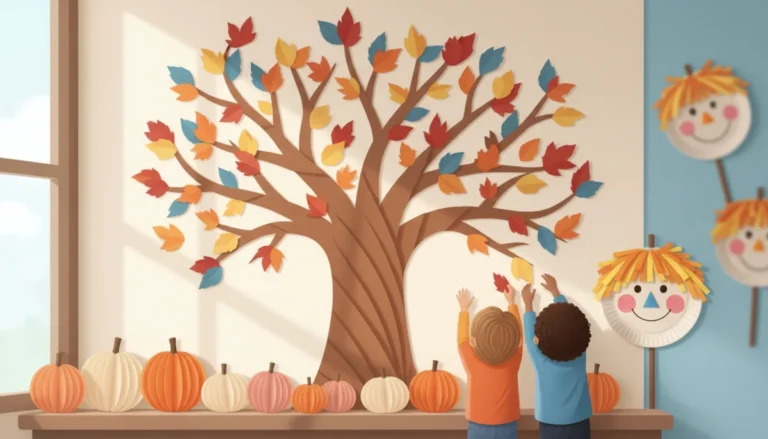
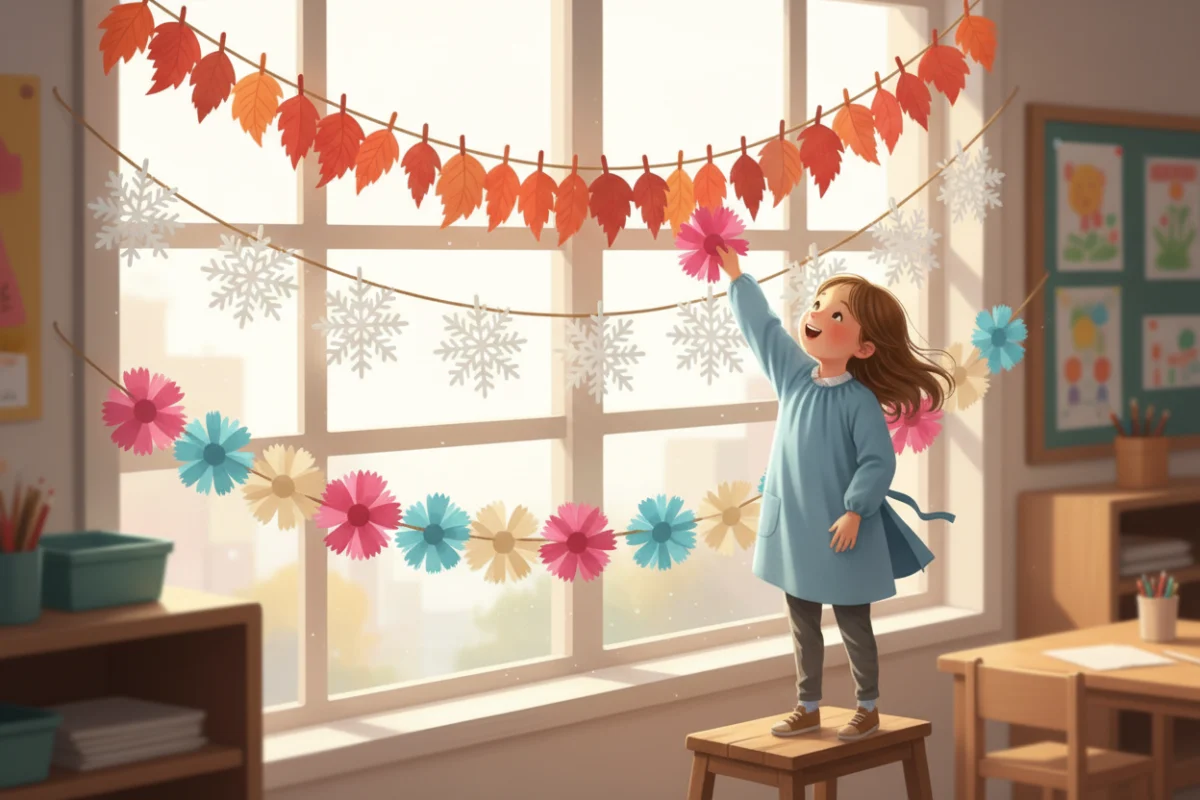
Shape garlands. Children cut hearts, leaves, stars or pumpkins and glue them to yarn at intervals. See our fall paper crafts for seasonal shapes.
Folding level
Accordion garlands. Fold a strip back and forth, cut a shape through all layers with the fold at the edges, and open it into a row of joined figures.
Variations by season
- Fall: leaf shapes in red, orange and yellow; a pumpkin chain in orange and green; an apple garland.
- Winter: snowflake chains from folded and cut squares; a chain of mittens; white and blue fringe streamers.
- Spring: flower garlands with fringed petals; a caterpillar chain in green; raindrop shapes on blue yarn.
- Summer: a sun garland with fringed rays; fish shapes on a wavy blue strip; an ice cream cone chain.
- Any time: a “class chain” that grows all year, one loop per child per week, with the child’s name written on each loop.
Patterns, counting and measuring
Chains are a natural math activity. Make an AB pattern, then an ABC. Count loops at circle time. Predict whether the chain will reach the window, then check. Make a “countdown chain” to a special day and remove one loop each morning. Write numerals on the loops to create a number line above the whiteboard.
Troubleshooting the usual problems
Loops that spring open: the child let go too early or used too little glue. Teach “hold for five” and, for the youngest, switch from glue stick to a dot of white glue. Strips cut too short to loop: mark the cutting lines yourself for children who cannot yet judge length, or give them a card template to cut against. Chains that are all one child’s work: give each child a color and ask that every color appears in the chain, so nobody can build it alone. Glue everywhere: put the glue in a shallow lid with a cotton swab as an applicator, which limits the amount that reaches the table.
A child who refuses to cut but wants to contribute can be the “linker,” threading and gluing strips that others cut. Over a few weeks, most linkers start cutting too.
Making the chain a class ritual
Some teachers open every morning with two minutes of chain-building: each child adds one loop while arrival music plays. It is a calm transition, it guarantees daily cutting for everyone, and by December the chain circles the room. Others reserve chains for Friday afternoons as a reward. Either works. What matters is that the chain is always somewhere children can add to it, and that its growth is noticed and celebrated.
Hanging and storing
Hang chains from a length of string rather than from the chain itself, which tears. Use removable adhesive hooks along the top of the wall so you can swap displays without damage. Store the best chains in a shallow box between seasons, folded loosely in tissue paper. Fringe streamers do not store well, so make them fresh.
Keeping it going all year
Set a “garland goal” for each month and keep the strips at your cutting station so children add loops during free choice. Our guide to setting up a cutting station explains the routine. The chain becomes the visible record of how much cutting the class has done, and children love watching it grow.
Chains for older children
First and second graders still enjoy chains, but they need more challenge. Have them measure and cut strips with a ruler, design a pattern with three or four colors, write a word on each loop to build a sentence chain, or make a chain where every loop is a different shape. A “reading chain,” with one loop for every book the class finishes, motivates both reading and cutting and is a popular year-long display.
At home
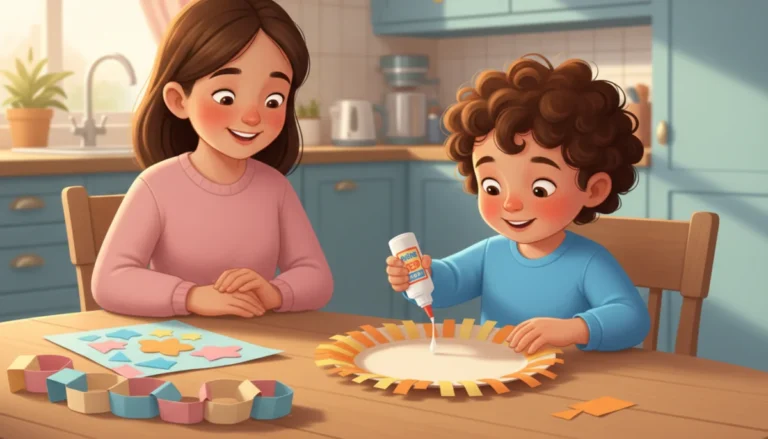
Families can do all of this with a pack of construction paper and a glue stick. A birthday countdown chain, a garland for a party, or a rainy afternoon of fringe streamers are all cutting practice in disguise. Our easy paper crafts to make at home has more.
For holiday versions of the chain, see our Christmas paper crafts, Valentine’s Day crafts and the 100th day of school, where a chain of exactly 100 loops is the centerpiece.
Frequently asked questions
What age can children make paper chains?
From about three, with pre-cut strips and help gluing. By five, most children can cut their own strips and link them independently.
What is the best glue for paper chains?
A glue stick for children five and up; a small dot of white glue, held for a count of five, for younger children whose loops tend to spring open.
How wide should the strips be?
About one inch wide and six inches long for a standard chain. Wider strips (one and a half inches) are easier for the youngest children to cut and curl.
How do I stop the chain tearing when it is hung?
Hang it from a string threaded through the first and last loops, and support long chains every few feet with a hook.