“He just scribbles all over the page.” “She refuses to color at all.” “He is five and still cannot stay in the lines.” Coloring is one of the first things parents compare between children, and one of the first things they worry about. Most of the time, the worry is misplaced. Coloring develops in a predictable order, and a child who is behind is usually just a child who has not colored much.
This guide lays out what coloring typically looks like at each age, why it matters more than it seems, how to help, and the few situations where it is worth asking for advice.
Why coloring matters
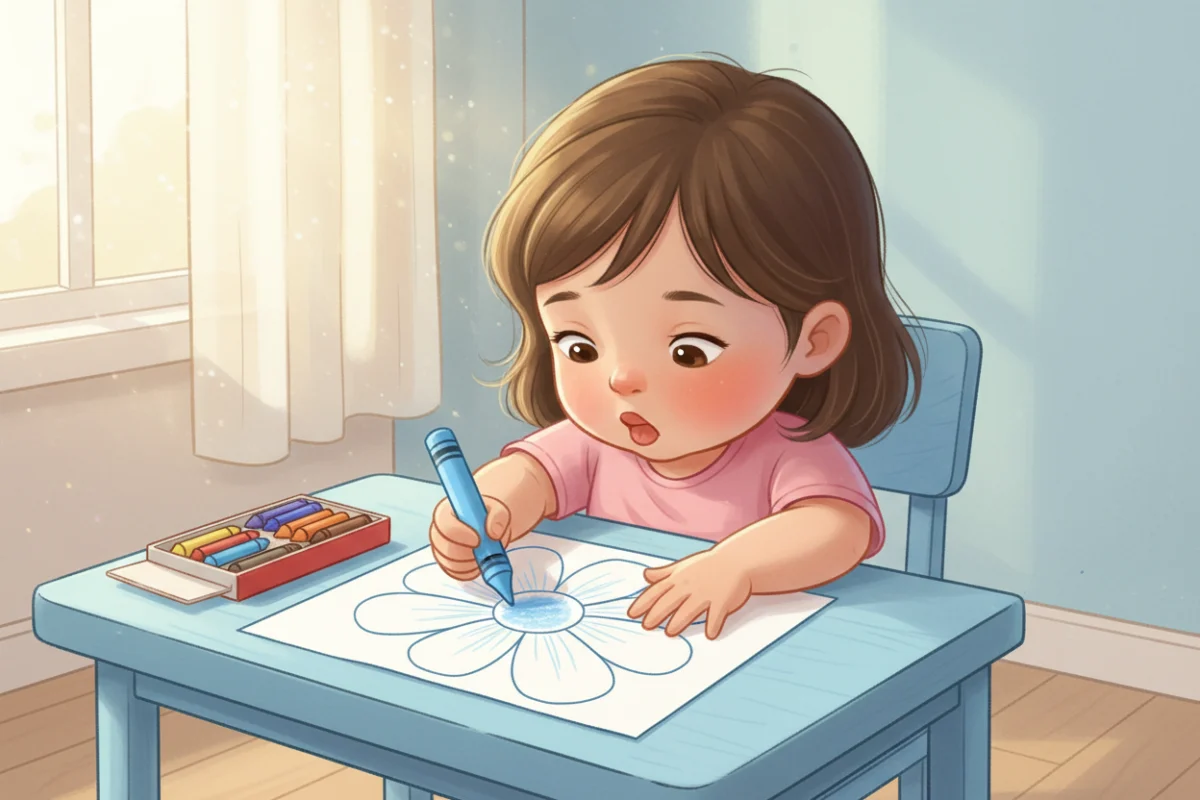
Coloring looks like play, and it is. It is also a compact fine motor workout. A child who colors is practicing a pencil grasp, controlling pressure, guiding the hand with the eyes, moving the wrist and fingers in small strokes, and holding the paper with the other hand. Those are the exact ingredients of handwriting, which we describe in our guide to graphomotor skills.
Coloring also builds stamina. Sitting and coloring for ten minutes is good preparation for sitting and writing for ten minutes. And it is one of the few fine motor tasks most children choose voluntarily, which makes it a cheap way to get practice in.
What coloring looks like at each age
Ages are approximate. Children with older siblings and easy access to crayons are often ahead; children with little practice are often behind, regardless of ability.
Around age 2 to 3: scribbling
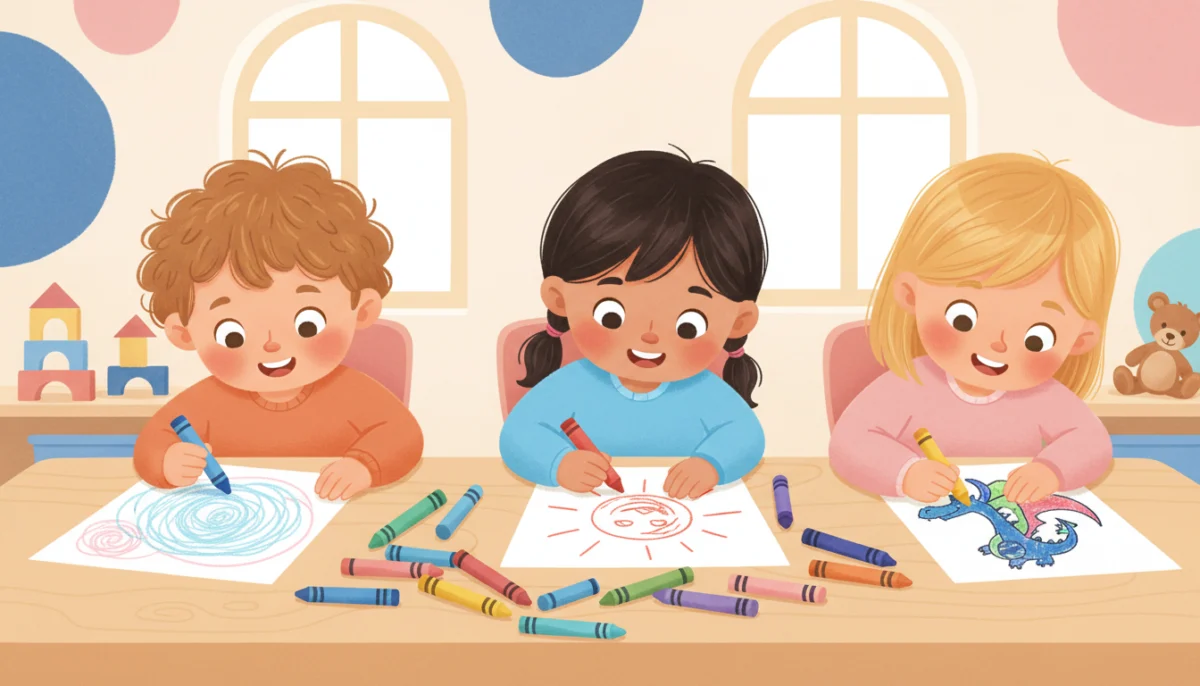
Scribbles that cover the page with no regard for the picture. Whole-arm movements, a fist grasp on the crayon, frequent switching between hands. Marks may go off the paper. This is normal and it is where everyone starts.
Around age 3 to 4: scribbling with intent
The child begins to notice the picture and scribbles “on” it, usually in one color. The strokes are still big and go outside the lines freely, but there is an attempt to cover a shape. Grasp is moving toward the fingers. The child can color a large simple shape with roughly half of the marks inside.
Around age 4 to 5: inside the lines, mostly
Strokes get smaller and more controlled. The child colors a large shape with most marks inside and starts to use several colors on purpose. Direction of strokes may still be random. The helper hand starts to hold the page. Filling in a whole picture is tiring and the child may stop halfway.
Around age 5 to 6: control and completion
The child colors within the lines of medium-sized shapes with only small overshoots, uses consistent strokes in one direction, chooses colors deliberately and finishes a picture. Pressure is more even. Grasp is close to mature. Small details are still hard.
Around age 6 to 7: precision
Detailed coloring pages with small areas become possible. The child shades, changes pressure on purpose and colors for longer periods. This is the point where coloring and handwriting most obviously overlap.
What “normal” does not require
Some things parents worry about that are not worth worrying about:
- A preschooler using one color for the whole picture.
- A four-year-old who colors the sky green.
- Stopping after two minutes at age three or four.
- Holding the crayon in a fist at age three, or in a four-finger grasp at age four. Our guide to pencil grasp development shows the normal stages.
- Coloring outside the lines of a detailed page at age five. The page is too hard, not the child.
How to help a child who scribbles or avoids coloring
Make the pages easier
Big, simple shapes with thick outlines suit ages three to four. Detailed pages belong with older children. If your child scribbles across a page of tiny flowers, the page is the problem.
Give better tools
Short, chunky crayons or broken crayon pieces push the fingers into a better grasp. Triangular crayons help too. A big page taped to a wall or easel makes coloring easier for a child who slumps at a table.
Build the hand first
If your child avoids coloring, the hand may simply be tired quickly. Play dough, tearing paper, threading, cutting and other fine motor activities at home build the strength that makes coloring pleasant.
Change the task
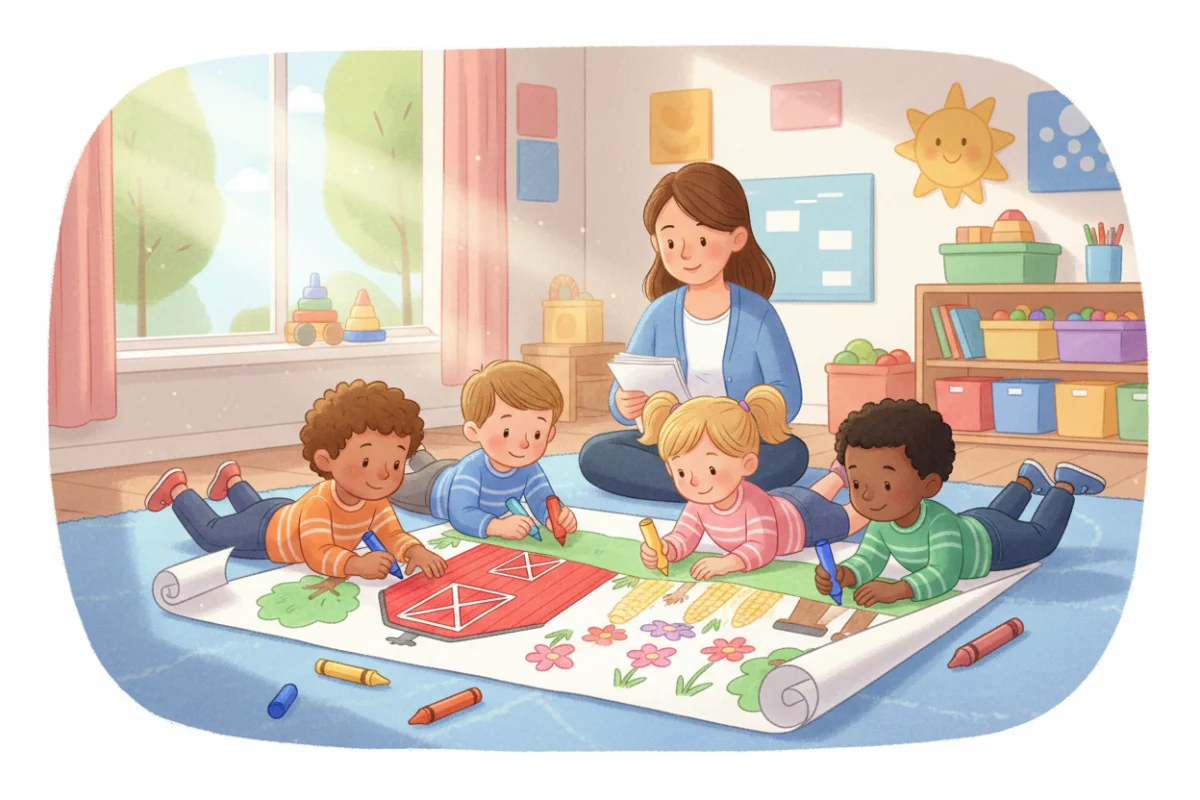
Color together, taking turns on the same picture. Color a giant poster on the floor with markers. Use dot markers, which need no line control. Color on textured surfaces. Try “color the parts” games: “color everything round blue.”
Keep it short and positive
Two minutes of willing coloring beats ten minutes of nagging. Praise effort, not neatness. Never make a child redo a page.
Choosing coloring pages that match your child
The single most useful thing a parent can do is match the page to the stage. A good rule: the areas to color should be at least as big as your child’s palm at age three, as big as a fist at age four, and as big as a couple of fingers at five. Thick outlines help at every age because they forgive small overshoots and give the eye a clear target.
Giant coloring posters are a great option for preschoolers. Spread on the floor, they invite big arm movements, let several children work at once and take the pressure off any one small area. For a five- or six-year-old, a page with a mix of large and small areas lets them choose their own challenge. Themed pages tied to something your child loves, such as dinosaurs, vehicles or seasons, keep attention for longer than generic ones.
Coloring and pencil pressure
Watch how hard your child presses. Heavy pressers snap crayons and tear paper; light pressers leave faint, patchy color. Both are common and both improve with practice. For a heavy presser, try crayons on a soft surface like a magazine. For a light presser, use soft, waxy crayons or markers that give bold color without force, and build hand strength through play. Neither needs correction in the moment.
When to look closer
Talk to your child’s teacher or pediatrician if, around age five, your child:
- still scribbles with a whole-arm movement and a fist grasp,
- cannot color a large simple shape with most marks inside,
- switches hands constantly and shows no preference,
- becomes very distressed by coloring or refuses it completely over many months,
- also struggles with dressing, using utensils, cutting or building.
Coloring on its own is rarely the issue, but it can be an early, visible sign of fine motor or visual-motor difficulties that respond well to help.
For help picking pages that fit, see how to choose coloring pages for your child’s age, and for a group activity that works from age two, giant coloring posters.
Holiday coloring pages are the most common kind: our giant coloring posters and the kids’ table kit in Thanksgiving crafts for kids show how to use them well.
Frequently asked questions
At what age should a child color inside the lines?
Most children color mostly inside the lines of large shapes by around age four to five, and of medium shapes with small details by six. Precision on detailed pages comes around age six to seven.
Is it bad if my three-year-old just scribbles?
No. Scribbling is the normal first stage of coloring. Offer big simple pictures and chunky crayons and let it develop.
My five-year-old hates coloring. Should I worry?
Not necessarily. Many children find coloring tiring or boring. Try shorter sessions, easier pages, vertical surfaces and fine motor play. Mention it to the teacher if refusal is strong and long-lasting.
Does coloring help with handwriting?
Yes. Coloring builds pencil grasp, pressure control, eye-hand coordination and stamina, all of which transfer directly to writing.