Valentine’s Day in an early childhood classroom is really a day about cutting hearts, writing names and being kind. Strip away the candy and it is one of the best handwriting and scissor days of the year: every child writes twenty names on twenty cards, cuts a dozen hearts, and decorates a mailbox. Handled well, it also becomes a lesson in inclusion, because everyone gets a card from everyone.
Here are crafts sorted by skill, a card-making plan that turns the day into handwriting practice, kindness activities that give the holiday some depth, and a party plan that keeps the sugar low.
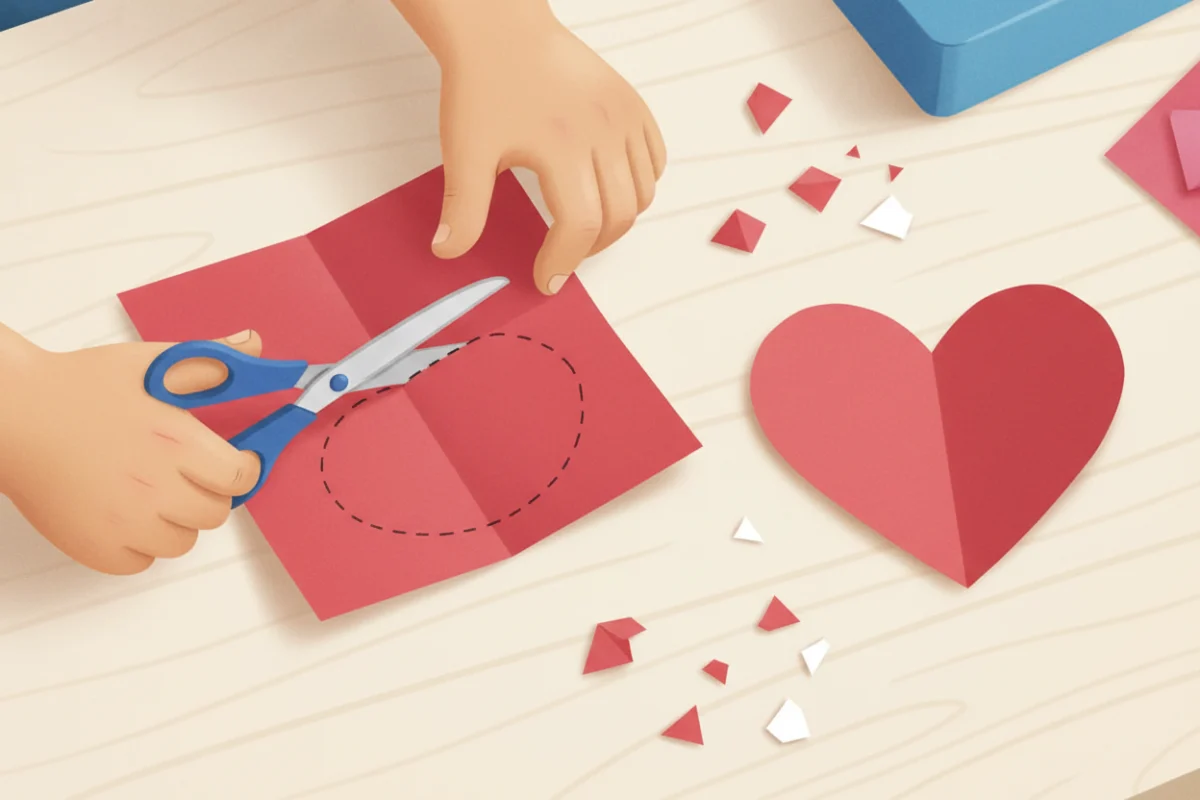
Cutting hearts, the right way
A symmetrical heart is one of the hardest shapes for a young child to cut, and one of the most satisfying once they can. The trick is the fold: fold the paper in half, draw half a heart against the fold, cut, open. Children who cannot draw the half-heart can cut along a line you draw; children who can, draw their own. Our guide to scissor skills by age explains why curves and folds come late in the sequence, so three-year-olds tear hearts from paper instead, which works fine.
Heart crafts by level:
- Torn paper hearts: pink and red paper torn and glued inside a big heart outline. Pre-K.
- Fringed hearts: a cut heart with the edge snipped all the way around. Snipping.
- Heart garland: cut hearts strung on yarn across the room. Our paper chains and garlands article has the stringing tips.
- Heart animals: hearts of different sizes assembled into a mouse, a fox, an owl or a butterfly. Spatial planning.
- Woven heart baskets: two folded shapes woven together into a heart-shaped pocket. First and second grade; bilateral coordination.
- Heart chain: a paper chain in red, pink and white, with a heart glued on every fifth loop.
- Accordion heart caterpillar: hearts glued to an accordion-folded strip.
Card-making as handwriting practice
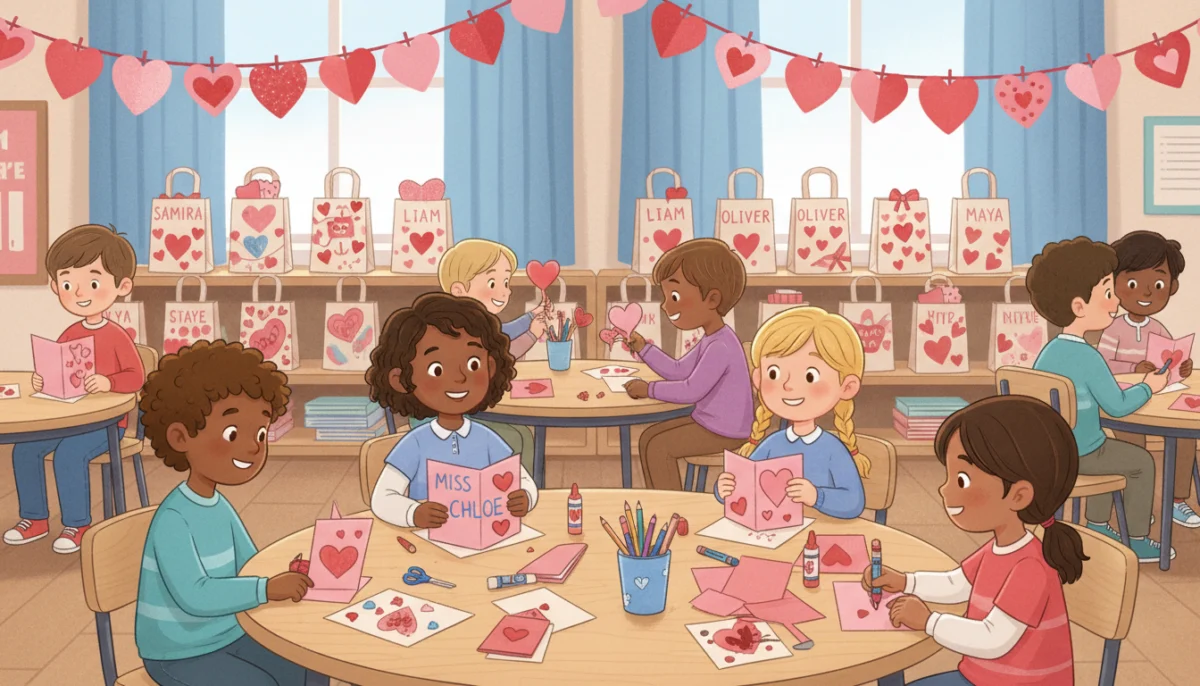
The class card exchange is a handwriting lesson in disguise. Send home a class list two weeks ahead and ask families to have children write the names themselves, even if it takes several sittings. In class, set up a card center with folded card, heart shapes, stamps and markers, and have each child write “To” and “From” and their name on the cards they make there.
For pre-K, the child writes their own name and an adult writes the recipient’s. For kindergarten, both names. For first and second grade, a short message too. Our guides to name writing and letter formation cover what to expect at each stage.
Twenty names written with care is more handwriting than most children do in a week, and every one of them has a purpose.
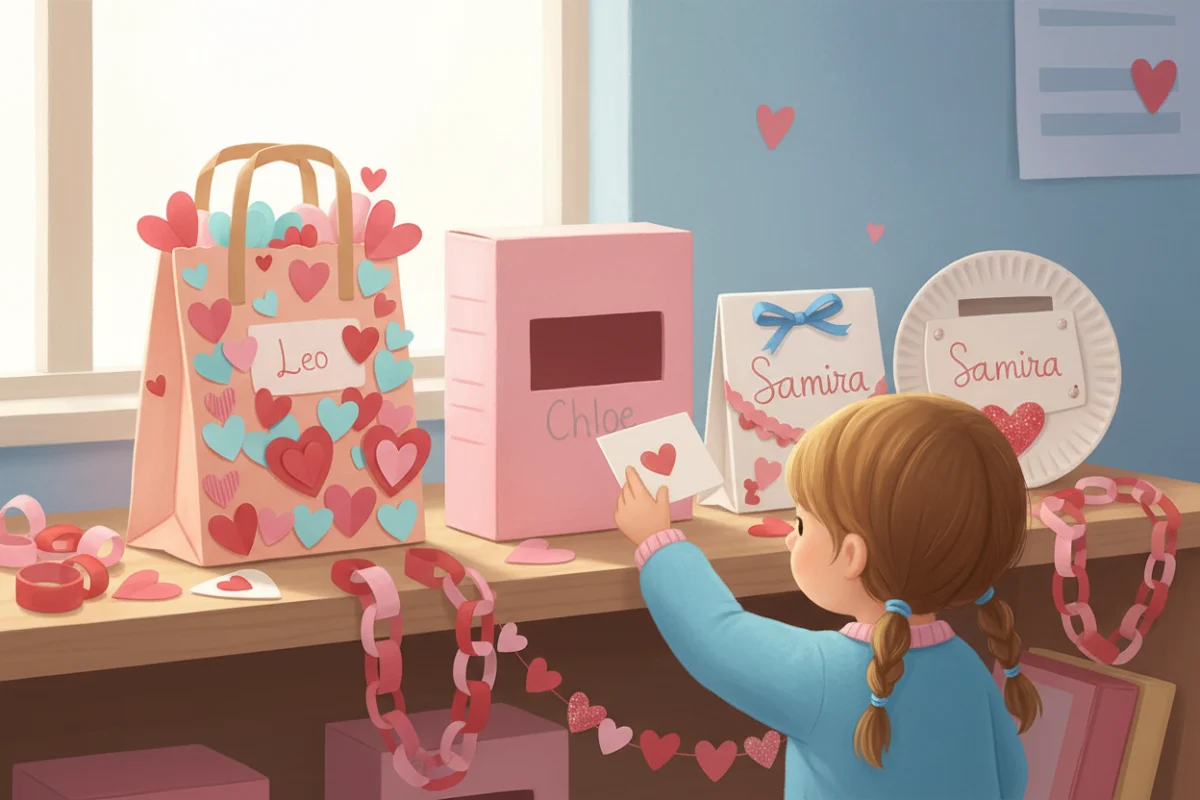
Mailbox crafts
Every child needs a mailbox for the exchange, and making it is a craft in itself.
- Decorated paper bag: a lunch bag with a cut paper heart, the child’s name and stickers. The simplest option.
- Cereal box mailbox: a cereal box covered in paper with a slot cut in the top. Older children cut the slot themselves.
- Paper plate pocket: two plates, one cut in half, stapled together to make a pocket, decorated.
- Envelope mailbox: a large envelope decorated with hearts and taped to the desk.
- Tissue box mailbox: an empty tissue box wrapped in paper, with the existing hole as the slot.
Make the mailboxes the week before so they are ready on the day.
Kindness activities
Valentine’s Day is a good moment to talk about kindness beyond cards.
- Kindness chain: every kind act noticed in class adds a loop to a chain. Aim to reach the door by the 14th.
- Compliment hearts: each child gets a heart with their name; classmates write or dictate one kind thing about them.
- Secret kindness: children draw a classmate’s name and do something kind for them during the week without saying who.
- Heart hunt: hidden paper hearts around the room, each with a kind message to read aloud.
- Cards for others: make cards for a nursing home, the school office or the cafeteria staff, and deliver them.
A two-week plan
Week one: mailboxes at the craft center, the class list goes home, the kindness chain starts, and the heart garland goes up as a cutting task at the cutting station. Week two: card center open every day for children to make and write cards for anyone they did not do at home, compliment hearts at circle time, heart animals or woven baskets as the main craft, and the party on the 14th or the nearest school day. The kindness chain is measured on party morning; if it reaches the door, the class earns an extra story.
Keep a quiet table with pre-cut hearts and glue for children who find the cutting hard, so nobody misses the fun because of scissors. Our cutting station article explains how to keep two difficulty levels available all the time.
Math and literacy links
Hearts sort by size and color, count in tens on the garland, and make patterns on the chain. Conversation hearts (real or paper) sort by word and color. A “how many cards did you get” tally is a graph everyone cares about. On the literacy side, the class list is a reading task, “To” and “From” are sight words with a purpose, and compliment hearts are dictated or written sentences. A short whole-class read-aloud about friendship or kindness each morning of party week ties it together.
A low-sugar party plan
Run the party as centers, as in our Halloween party plan: a craft (heart animals), a game (heart bean bag toss or “find the matching heart”), the card exchange (children deliver their cards to the mailboxes, then open their own), and a snack table with strawberries, heart-shaped sandwiches or crackers and one treat. Ask families for one non-food item each (stickers, pencils, bubbles) if you want to avoid candy entirely.
The card-opening moment is the highlight. Give it time, sit on the rug, and let children read or show their favorite card.
Watching hands on card day
Twenty cards written in a week is a natural check on handwriting. Look at the “From” lines: is the name written with a capital and lowercase letters, started at the top, roughly the same size each time? Children whose twentieth card looks like the first may be tiring quickly or pressing hard; our guide to pencil pressure covers what to do. Note who avoided the card center altogether, and follow up gently in the weeks after.
For families
Send home the class list, a note about the card-writing plan, and a link to our easy paper crafts for preschoolers for families who want to make cards from scratch rather than buying them.
Frequently asked questions
How do I teach kids to cut a heart?
Fold the paper in half, draw half a heart against the fold, cut along the line and open. Start with big hearts and thick lines; move to child-drawn half-hearts as skill grows.
What are easy Valentine’s crafts for preschoolers?
Torn paper hearts, decorated paper bag mailboxes, heart chains with pre-cut hearts and fingerprint hearts all suit three- and four-year-olds.
How do I make Valentine’s cards a handwriting activity?
Have children write every name themselves, at home over several sittings and at a card center in class, with the level of writing matched to age: own name in pre-K, both names in kindergarten, a message by second grade.
How do I make sure every child gets a card?
Send the full class list home, require a card for every classmate, and keep a stack of spare cards so any gap can be filled quietly on the day.