The 100th day of school is one of the best days of the year for a kindergarten or first grade teacher. It has a built-in theme, a built-in math lesson, no religious complications and no candy requirement. Children have been counting toward it since September on the number line, and when it arrives they are ready to do everything one hundred times.
Here are thirty activities sorted by type, with a special focus on the ones that build fine motor skills, plus a schedule for the day and a note on the home project.
Counting collections
The classic home project: bring in 100 of something. Send the note two weeks ahead with examples (buttons, pasta, cotton balls, bottle caps, stickers, beads, cereal) and a request to arrange them in groups of ten on a poster or in a bag. On the day, children present their collection and the class counts by tens together.
For children who forget, keep a box of pasta and paper plates at school so nobody is left out. Counting and arranging a collection is fine motor work in itself, especially with small items.
100-piece crafts
Each of these uses exactly 100 pieces, which makes the counting part of the craft.
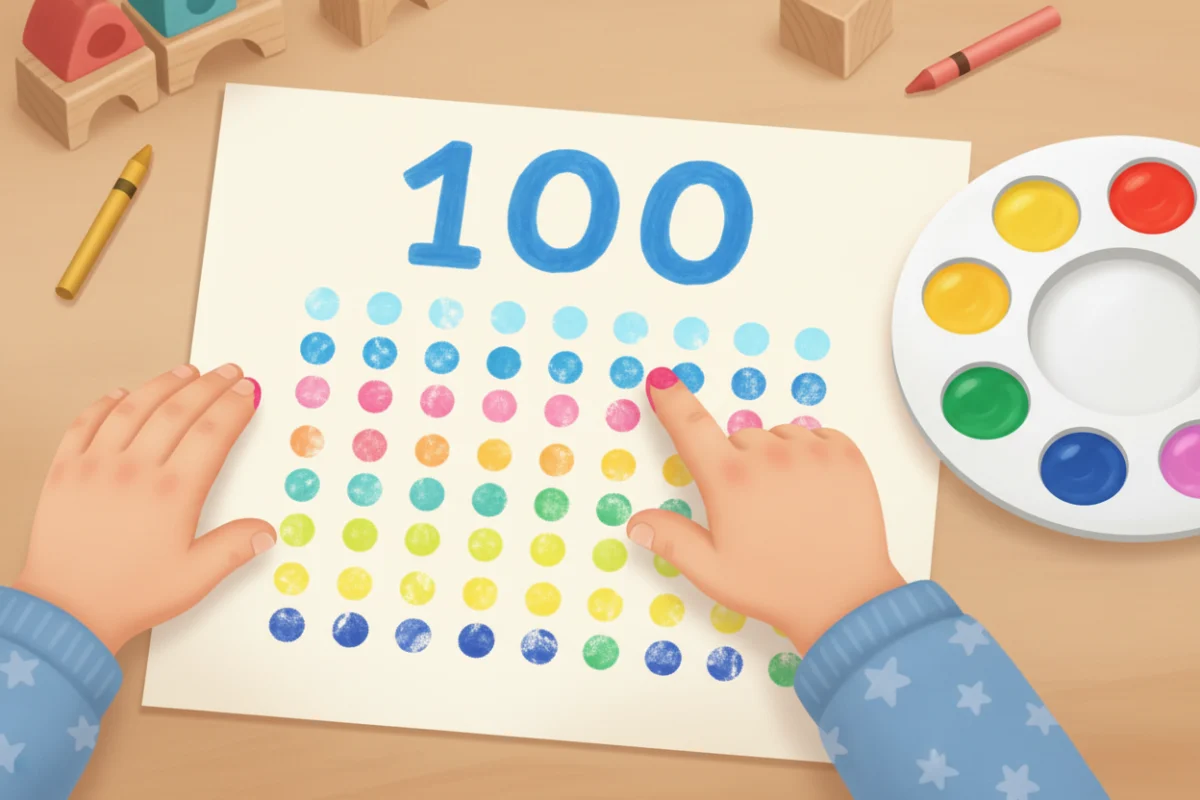
- 100 fingerprints: ten rows of ten fingerprints in paint, one color per row. Pinch and press.
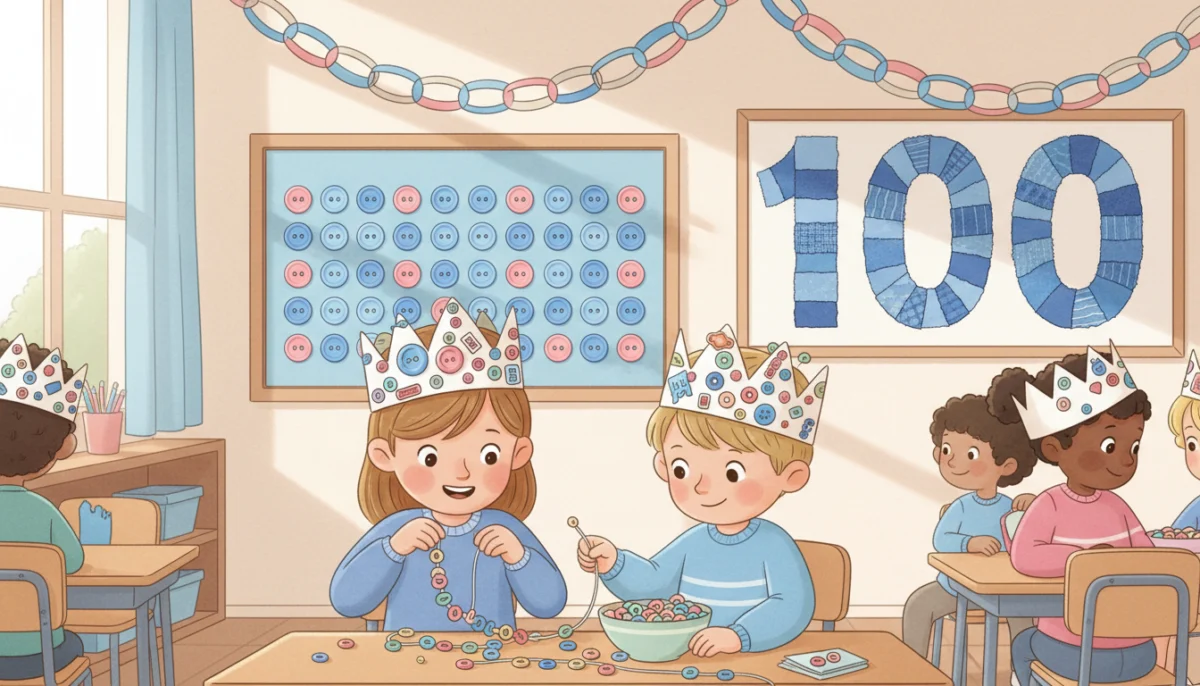
- Fruit loop necklace: 100 cereal rings on a string, counted in tens with a knot between groups. Threading and counting.
- 100-cup tower: a class challenge to stack 100 paper cups. Placement and control.
- 100 dot picture: a picture made with 100 dot marker dots or stickers.
- 100 sticker crown: a paper crown with 100 stickers in rows. Peeling small stickers is pinch practice.
- 100-piece collage: 100 small squares of paper cut and glued into a shape. See our guide to scissor skills by age for how to run the cutting.
- Paper chain of 100: a class chain with 100 loops, in tens by color. Our paper chains article has the method.
- 100 hole punches: a strip of card with 100 punched holes. Hand strength, and children love the confetti.
- 100 play dough balls: roll 100 small balls and arrange them in a ten-by-ten grid.
- 100 building blocks: build a structure with exactly 100 blocks.
Fine motor challenges
Time these with a sand timer and record the results.
- How many cubes can you stack in 100 seconds?
- How many beads can you thread in 100 seconds?
- How many pom-poms can you move with tweezers in 100 seconds?
- How many times can you write your name in 100 seconds? (Our guide to name writing makes this one a good check of progress.)
- Can you cut a strip into 100 pieces?
- How many clothespins can you clip in 100 seconds?

Math centers
- 100 chart puzzles: a hundred chart cut into pieces to reassemble.
- Roll to 100: roll a die, color that many squares on a hundred chart, race a partner.
- What weighs 100? Compare objects to 100 cubes on a balance.
- 100 in coins: how many ways to make a dollar.
- Ten frames: fill ten ten-frames with counters to make 100.
- 100 seconds: what can you do in 100 seconds? Jumping jacks, hops, claps.
Writing and drawing
- “When I am 100 years old I will…” with a drawing.
- “I wish I had 100…” with a drawing.
- “100 things I can do” class book, one thing per child.
- Draw yourself at 100: with a mirror and grey crayons.
- A list of 100 words the class can read, built on chart paper across the morning.
The 100-year-old dress-up
Many classes invite children to come dressed as 100-year-olds: cardigans, glasses, grey hair spray, canes. It is optional and fun, and pairs with the “when I am 100” writing. Teachers who prefer not to do costumes can make the 100 sticker crowns instead and hold a crown parade.
Adapting by grade
Kindergarten: keep the counting concrete. Collections in tens, fingerprints and necklaces, 100-second challenges with physical objects, and the “when I am 100” drawing. Skip the coin center. First grade: add the hundred chart puzzles, roll to 100, the 100-piece collage and the class word list. Second grade: the coin center, weighing, a written paragraph about being 100, and a challenge to build the tallest structure with exactly 100 blocks. In a mixed class, run the centers with two levels on each table, as our guide to fine motor centers describes.
Prep the week before
Send the collection note home ten days ahead and remind families twice. Cut paper strips for the class chain and squares for the collage on a paper cutter. Set out the counting station with cups, plates and pasta for children who arrive without a collection. Print a hundred chart per child and a few extras. Gather ten kinds of snack items and a paper plate per child, and draw a ten-by-ten grid on each plate. Ask a parent volunteer for the morning; centers with young children run far better with a second adult.
Displays and keepsakes
The 100 fingerprints and the “when I am 100” drawings make a hallway display that families stop to read. The class chain of 100 loops hangs across the room until spring. Keep one 100-piece craft per child for the portfolio; it makes a good comparison with the work from the first week of school.
A plan for the day
Morning meeting: count to 100 by ones, fives and tens; add the 100th link to the countdown chain. Collections: children present and the class counts. Centers: four rotations of fifteen minutes through a craft (choose two from the list), a fine motor challenge, a math center and a writing task. Snack: a “100 snack” with ten each of ten items (cereal, raisins, pretzels, crackers) sorted onto a paper plate grid, which is counting and pinching at once. Afternoon: read-aloud of a 100th day picture book, the “100 things we can do” class book, and the crown parade.
The whole day is built from sorting, threading, stacking, punching, cutting and writing, which is why it is one of the best fine motor days of the year without anyone noticing.
Why the 100th day is a fine motor day
Look at the list again with a hand-skills eye. Peeling 100 stickers, threading 100 cereal rings, punching 100 holes, rolling 100 play dough balls, moving pom-poms with tweezers, cutting a strip into pieces and stacking cups all train the pinch, the separation of the two sides of the hand and the eye-hand control that our guide to graphomotor skills describes as the foundation of handwriting. A child who does four of these centers in one morning has had more fine motor practice than in a typical week, and every minute of it was framed as a celebration.
For families
Send home the collection note early, and afterward our fine motor activities at home list, since many of the day’s challenges (tweezers, threading, clothespins) are easy to repeat at the kitchen table.
Frequently asked questions
When is the 100th day of school?
Usually in late January or February, depending on the school calendar and snow days. Most classes count the days on a number line from the first day.
What can my child bring for 100 things?
Small, countable items: buttons, pasta, cereal, cotton balls, bottle caps, beads, stickers, coins or pom-poms, arranged in ten groups of ten.
What are good 100th day activities for kindergarten?
Counting collections, 100 fingerprints, fruit loop necklaces, 100-second challenges, 100 sticker crowns and a class paper chain of 100 loops.
Do we have to dress up as 100-year-olds?
No. It is a popular option, but the sticker crown parade or a “100 things I can do” book works just as well for classes that skip costumes.