Athletes warm up. Musicians warm up. Then we hand a six-year-old a pencil straight after recess and expect neat letters on the first try. A short warm-up before writing does two things: it gets the shoulders, wrists and fingers ready to work, and it signals to the class that writing time has begun. Five minutes is enough.
This guide gives you a bank of warm-up exercises sorted by what they train, then combines them into routines for pre-K, kindergarten and first grade. None of them need equipment beyond what is already in the room.
Why warm up at all
Handwriting is a whole-arm skill that ends at the fingertips. Stability comes from the trunk and shoulder, control from the wrist and the small muscles of the hand. If the shoulder is slumped or the fingers are stiff, letter quality drops no matter how well the child knows the forms.
Warm-ups also give heavy sensory input to children who need it, wake up the “helper hand” that will hold the page, and provide a predictable transition. Children who find writing hard often resist it. A playful routine lowers the barrier, and that alone is worth the five minutes. For the background on why shoulder and hand stability matter, see our guide to graphomotor skills.
Whole-body and shoulder warm-ups
These build the stability that everything else sits on. Pick one or two.
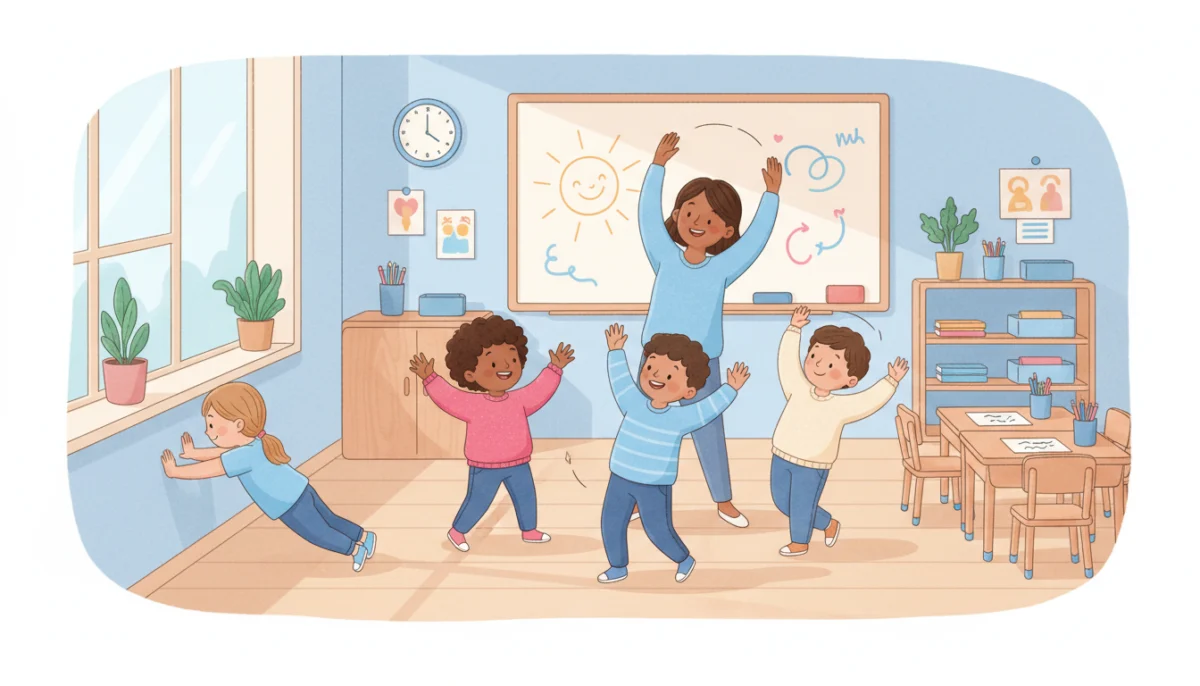
- Wall push-ups: hands on the wall at shoulder height, ten slow push-ups.
- Chair push-ups: hands on the seat of the chair, lift the body a few inches, hold, lower. Five times.
- Bear crawl or crab walk across the rug.
- Arm circles: big circles forward, big circles back, then small fast circles.
- Shoulder shrugs: up to the ears, hold, drop.
- Sky writing: draw giant letters or shapes in the air with a straight arm.
Hand and wrist warm-ups
These loosen the wrist and prepare the arch of the hand.
- Wrist rolls: hands in loose fists, roll both wrists ten times each way.
- Prayer stretch: palms together in front of the chest, lower the hands until you feel the stretch.
- Piano fingers: tap the fingers on the desk one after another, fast and slow.
- Spider push-ups: fingertips together, palms apart, push the palms in and out.
- Rain on the roof: drum all ten fingertips on the desk, soft then loud.
- Washing hands: rub the palms together vigorously, then the backs of the hands.
Finger warm-ups
These target the small muscles and the separation of the two sides of the hand, which matters for a mature grasp. Our guide to pencil grasp development explains why.
- Finger taps: touch the thumb to each fingertip in turn, then backward, then faster.
- Okay signs: make an O with thumb and index finger, then thumb and middle, and so on.
- Pinch and hold: pinch a small object (a cube, a bead, a pom-pom) between thumb and index finger and hold it up for a count of five, then switch fingers.
- Coin walk: move a coin from the fingertips to the palm and back without using the other hand.
- Finger fold: hold ring and pinky fingers in the palm while the other three wave.
- Rubber band stretch: put a rubber band around the fingertips and open the hand against it.

Stroke warm-ups
Once the hand is ready, spend the last minute on the actual movements. Do them large first, then small.
- Air strokes: vertical, horizontal, circle, cross, diagonal, drawn in the air with the whole arm while saying the name.
- Whiteboard strokes: the same set drawn large on a vertical surface, then rubbed out.
- Rainbow arcs: draw a large arc left to right with one color, then trace it with two more colors.
- Loops and bumps: a row of loops, a row of bumps, a row of zigzags across a strip of paper.
- Letter of the day: form the day’s letter three times in the air with the verbal cue, then once on the whiteboard.
For a fuller explanation of which strokes to use when, see our pre-writing strokes sequence.
Ready-made routines
Each routine takes about five minutes. Rotate them through the week so they stay fresh.
Pre-K routine
Wall push-ups (10), arm circles (10 each way), washing hands, finger taps (slow), air strokes for the week’s shape, then straight into the activity. Keep it playful: the strokes are “rain,” “fences,” “bubbles” and “crosses.”
Kindergarten routine
Chair push-ups (5), wrist rolls, spider push-ups, okay signs, pinch and hold, sky writing of the letter of the day, whiteboard letter with the cue. Total five minutes with transitions.
First grade routine
Bear crawl to the desk or arm circles, prayer stretch, piano fingers, coin walk, rubber band stretch, loops and bumps on a strip, letter of the day on the whiteboard. By first grade, children can lead this themselves from a chart.
Adapting warm-ups for children who need more
A few children will need the warm-up to work harder for them. For a child who presses too hard or seems to crave rough play, double the heavy-work part: extra wall push-ups, carrying the book bin, pushing the chairs in. For a child with a weak or floppy grasp, add a minute of pinching and squeezing with play dough or clothespins before the stroke drills. For a left-handed child, make sure the whiteboard practice happens with the paper or board angled the way they will write, so the warm-up transfers to the desk. For a child who finds transitions hard, give them the job of leading the routine; the responsibility often does more than the exercises.
None of these adjustments need to be visible to the rest of the class. The routine stays the same, and a few children simply do a little more of the part they need.
Warm-ups for a whole-class writing block
If your writing block is long, split the warm-up in two. Do the body and hand exercises at the start, then insert a thirty-second “shake and stretch” halfway through: stand, shake out both hands, roll the shoulders, sit back down. Children who would otherwise slump or fatigue in the second half get a reset, and you get a natural checkpoint to look at posture and grasp around the room.
Making it stick
Post the routine as a picture chart so children can follow it without you. Use the same order every time; the predictability is part of the point. Let a different child lead each day. Add music if it helps the transition. And keep it short: the moment a warm-up stretches past five minutes it becomes a lesson, and children stop treating it as the fun part.
If you have a child who tires quickly or whose writing looks very different from their peers’, warm-ups help but are not enough on their own. Our guide to messy handwriting in first and second grade covers what else to look at.
Frequently asked questions
How long should a handwriting warm-up be?
Three to five minutes. Longer warm-ups eat into practice time and lose the energy of a quick transition.
Do handwriting warm-ups really improve writing?
They improve readiness. Children write more neatly and for longer when the shoulder, wrist and fingers are prepared, and the routine reduces resistance to starting.
Can I do warm-ups without any equipment?
Yes. Everything in this article uses the body, the desk, the wall or a whiteboard. Rubber bands and coins are optional extras.
What is the most important warm-up?
If you only do one thing, do something for the shoulder (wall or chair push-ups) followed by the day’s strokes in the air. Stability plus movement covers most of the benefit.