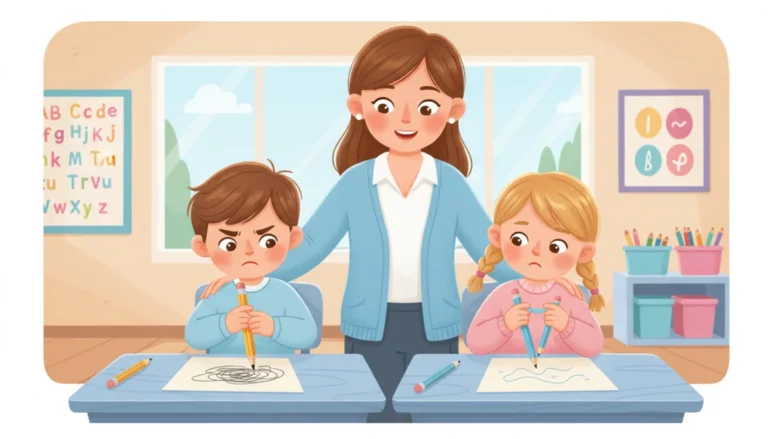
Every kindergarten teacher has met this child: bright, talkative, full of ideas, and completely defeated by a pencil. The letters float above the line, the hand gets tired after two words, and writing time ends in frustration. Very often the problem is not motivation, and it is not the alphabet. It is graphomotor skills.
This guide explains what graphomotor skills are, how they differ from fine motor skills, what typical development looks like between ages 3 and 7, and what you can do in an ordinary classroom, with ordinary supplies, to build them.
What are graphomotor skills?
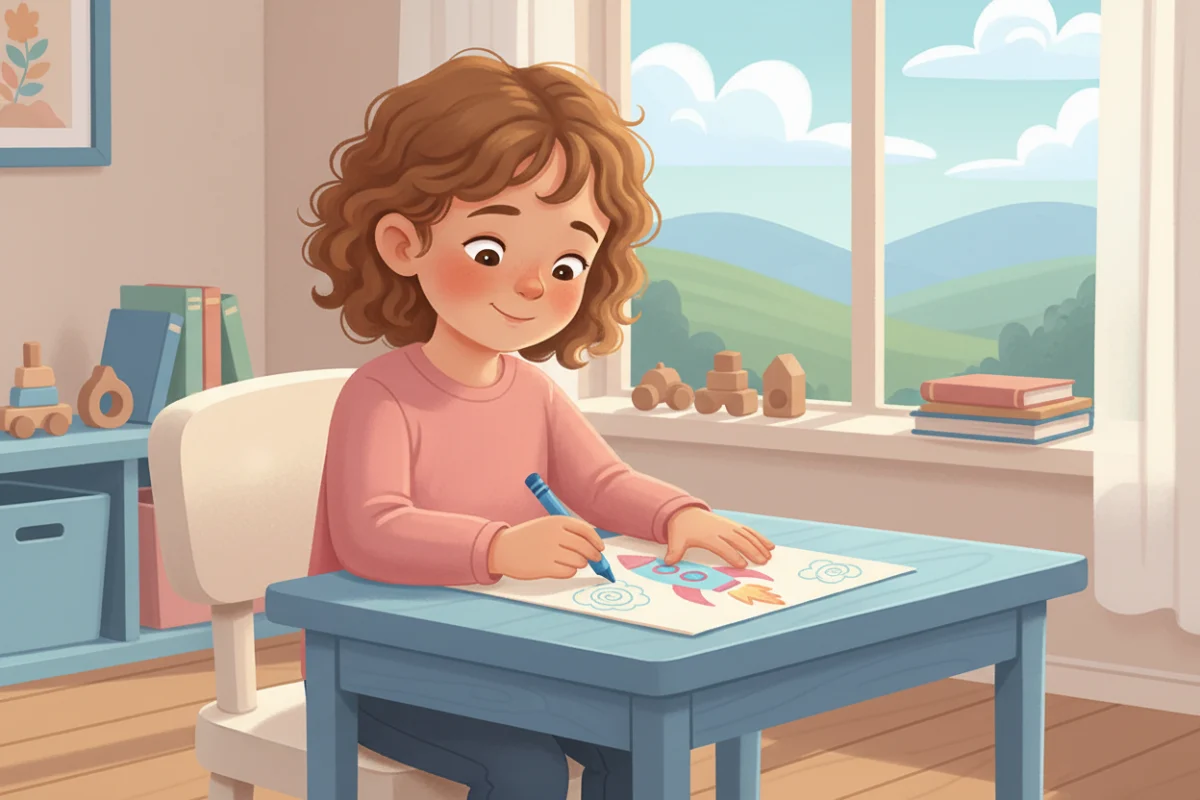
Graphomotor skills are the combination of abilities a child needs to make controlled marks with a writing tool: drawing lines and shapes, coloring inside a boundary, tracing a path, and eventually forming letters and numbers. The word joins two ideas, grapho (writing, drawing) and motor (movement). In other words, it is movement in the service of writing.
Handwriting looks like one skill from the outside. Underneath, it is a stack of smaller ones working together. When a first grader writes the word “cat,” she has to remember what each letter looks like, plan the movements, hold the pencil with the right amount of pressure, keep the paper still with her other hand, sit upright, and watch the line, all at the same time. Graphomotor skills are what make that coordination possible.
Graphomotor skills vs. fine motor skills
The two terms are often used as if they meant the same thing. They do not.
Fine motor skills are the broad category: any precise movement of the small muscles in the hands and fingers. Buttoning a coat, threading beads, using scissors, and opening a snack bag are all fine motor tasks.
Graphomotor skills are a narrower set that sits on top of fine motor skills. They add visual perception, motor planning, and the ability to control a tool on a surface. A child can be excellent with building bricks and still struggle to draw a diagonal line, because the pencil task asks for something extra: translating what the eyes see into a planned, controlled stroke.
This distinction matters in practice. If a child has weak hands, playdough and tweezers will help. If a child has strong hands but cannot copy a cross or a square, more playdough will not fix it. That child needs practice with strokes, shapes, and visual-motor activities.
The components of graphomotor skills
When you watch a child write, you are seeing several systems at work. It helps to know them, because each one points to a different kind of support.
- Postural control. Stable shoulders and a steady trunk give the hand a base to work from. A child who slumps, leans on the table, or wraps their legs around the chair is often compensating for a tired core.
- Hand strength and finger isolation. The thumb, index, and middle fingers do the skilled work while the ring and little fingers stabilize the hand. Children need enough strength to hold the pencil without gripping it for dear life.
- Pencil grasp. A functional grasp lets the fingers, not the whole arm, move the pencil. You can read more in our guide to pencil grasp development stages.
- Visual-motor integration. This is the ability to copy what the eyes see. It is the reason we ask young children to copy shapes before letters.
- Motor planning. Knowing where a stroke starts, which way it travels, and where it stops, and being able to repeat that plan until it becomes automatic.
- Bilateral coordination. One hand writes while the other holds and moves the paper. It sounds small. It is not.
- Pressure and speed control. Pressing too hard tears the paper and tires the hand. Pressing too lightly produces faint, wobbly lines.
- Spatial awareness. Sizing letters, keeping them on the line, and leaving spaces between words.
How graphomotor skills develop: ages 3 to 7
Children vary a great deal, so treat the ages below as rough guideposts, not deadlines.
Around age 3
Children typically scribble with purpose, imitate vertical and horizontal lines, and begin to draw a circle. Many still hold crayons with the whole hand or with the fingers pointing down toward the paper. Drawing is large and comes from the shoulder and elbow.
Around age 4
Most children can copy a circle and a cross, and start to draw simple people with a head and limbs. The grasp usually moves toward three or four fingers on the pencil. Coloring becomes more contained, though staying inside the lines is still hard.
Around age 5
Squares appear, along with the first diagonal lines, which are much harder than they look. Many children can write their own name, often in capitals. Movement begins to come from the fingers and wrist instead of the whole arm.
Ages 6 to 7
Children learn to copy a triangle, form all letters and numbers, and gradually control size and spacing. Over first and second grade, the goal shifts from accuracy to automaticity: letters that happen without conscious effort, so that the child’s attention is free for spelling and ideas.
You will find the full order of lines and shapes in our article on the pre-writing strokes developmental sequence.
Signs a student may be struggling
One of these on its own is rarely a concern. A cluster of them, lasting over time, is worth your attention.
- Avoids drawing, coloring, and writing, or finishes them as fast as possible
- Switches hands frequently after age 5 or so
- Holds the pencil in a fist or with a very tight, white-knuckled grip
- Complains that their hand hurts or is tired after a few minutes
- Presses so hard the paper tears, or so lightly the marks are hard to see
- Cannot copy shapes that most classmates manage
- Forms letters from the bottom up, or in a different way each time
- Writes far more slowly than peers, even when they know what to write
How to build graphomotor skills in the classroom
You do not need a special program. You need short, regular practice woven into things you already do.
Start big, then go small
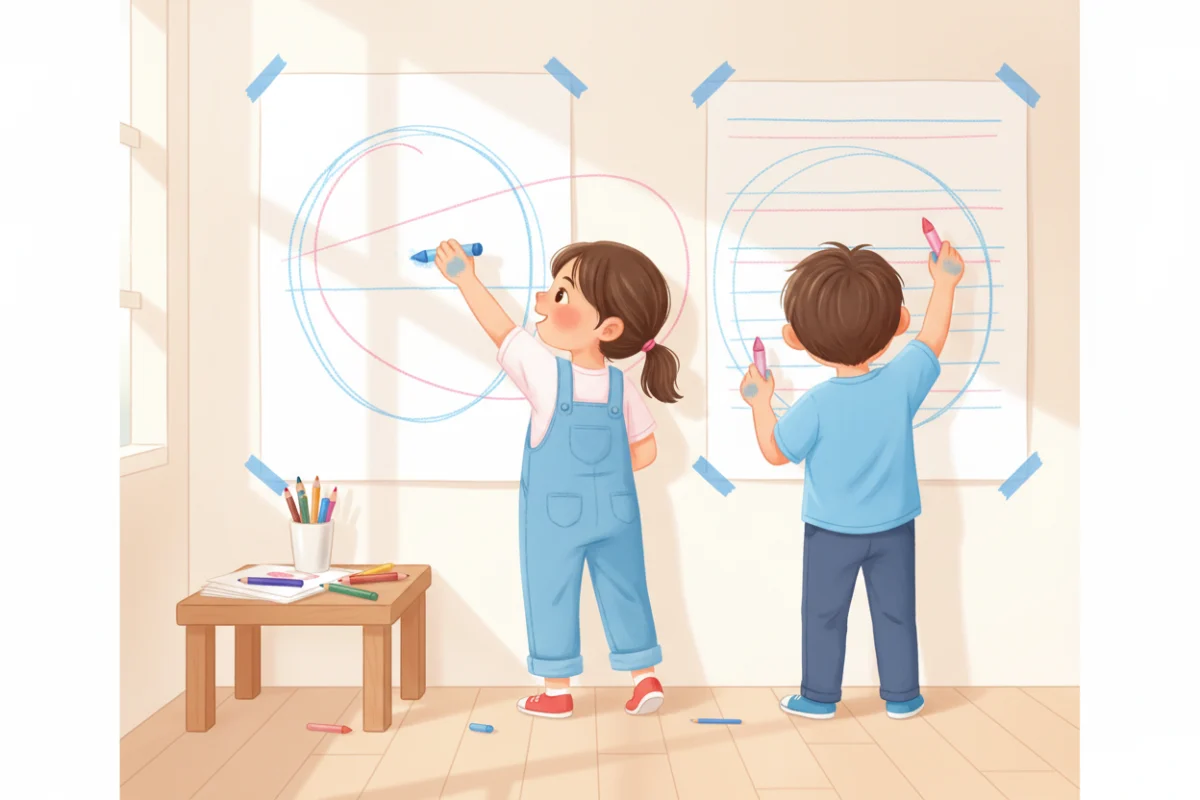
Large movements come before small ones. Let children draw lines and shapes in the air, on the carpet with a finger, on the playground with chalk, and on a whiteboard before you ask for the same stroke on paper. Big movement teaches the direction. Paper teaches the precision.
Put paper on vertical surfaces
Tape paper to the wall or use an easel. Working on a vertical surface places the wrist in a good position for writing, strengthens the shoulder, and makes it nearly impossible to slump. It is one of the simplest changes with the biggest payoff.
Use small tools
Broken crayons, golf pencils, and short pieces of chalk are hard to hold in a fist. They nudge fingers into a more mature grasp without any nagging from you.
Warm up before writing
Thirty seconds is enough: squeeze fists and stretch fingers wide, touch each finger to the thumb, press palms together, do wall push-ups. Warm hands write better.
Make fine motor work a daily center
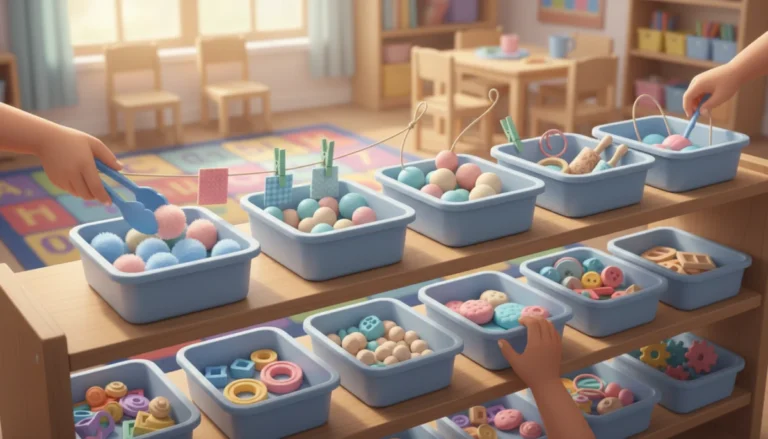
Tongs, clothespins, lacing, playdough, hole punchers, and scissors all build the hand strength that handwriting depends on. See our list of fine motor centers for handwriting for ideas that are easy to set up and easy to rotate.
Teach strokes and letters explicitly
Children do not pick up correct formation by looking at a finished letter. Model every stroke, say the movement out loud, and watch the first attempts so that mistakes do not get practiced into habits. Our step-by-step guide on how to teach letter formation covers the order and the cues.
Keep it short and frequent
Five to ten focused minutes a day beats one long session a week. Stop while it is still going well.
A word about worksheets
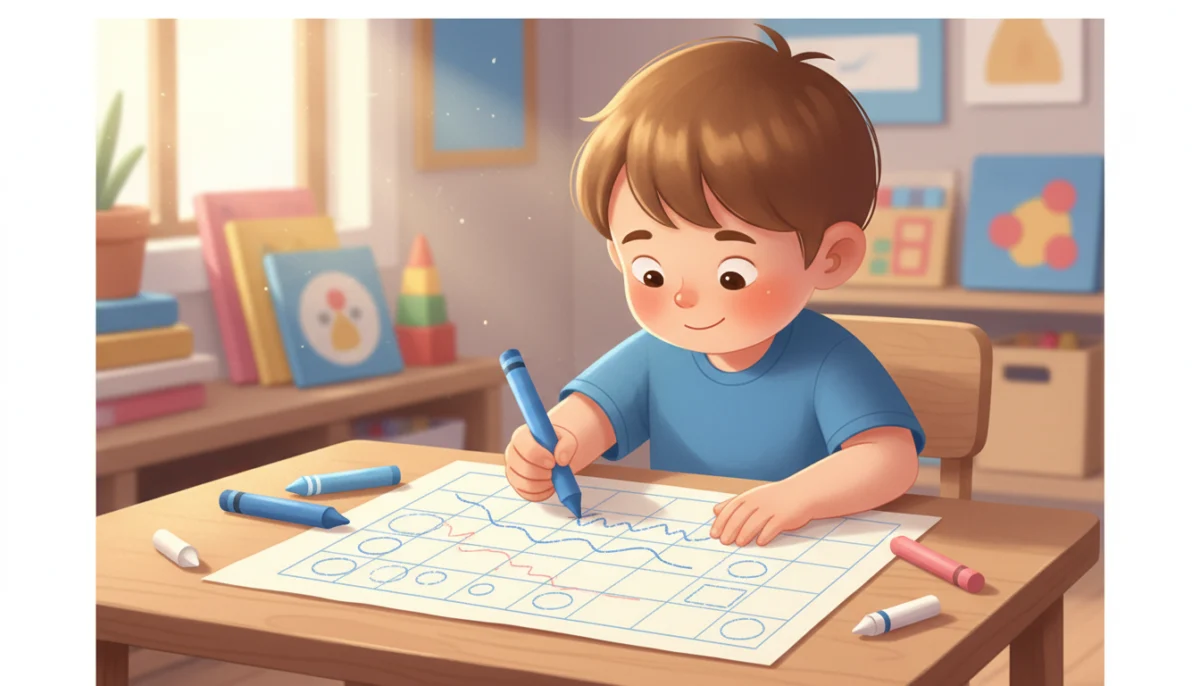
Tracing pages and pre-writing worksheets are useful, with two conditions. First, they come after hands-on work, not instead of it. Second, an adult watches how the lines are made, not just the finished page. A neatly traced letter formed from the bottom up is practice in the wrong direction.
When to involve a specialist
Classroom strategies help most children. If a student shows several of the signs above, is not making progress after a couple of months of consistent support, or is visibly distressed by writing tasks, talk with the family and follow your school’s referral process. An occupational therapist can assess what is going on underneath and suggest targeted support. This article is general information for educators and is not a substitute for an individual evaluation.
Frequently asked questions
Are graphomotor skills the same as handwriting?
No. Handwriting is the visible result. Graphomotor skills are the underlying abilities, such as visual-motor integration, motor planning, and pencil control, that make handwriting possible.
At what age should I start working on graphomotor skills?
You can start from age 2 or 3 through play: scribbling, painting, playdough, and drawing big lines. Formal letter practice can wait until a child can copy basic shapes, usually around ages 4 to 5.
How long does it take to see improvement?
With short daily practice, many teachers notice better control and more confidence within six to eight weeks. Progress is usually gradual, not sudden.
Do tablets and styluses count as practice?
They can help with stroke direction, but a smooth screen gives little feedback to the hand. Paper, chalk, and crayons provide resistance that builds control, so keep them at the center of your practice.