Halloween in an early childhood classroom is a balancing act. Children are excited weeks in advance, some families do not celebrate it, a few children are frightened by anything with fangs, and the sugar arrives whether you want it or not. The answer is not to skip it. The answer is to fill October with pumpkins, spiders, bats, leaves and the color orange, keep the spooky level low, and use the excitement to power a lot of fine motor and math practice.
Here are twenty activities that do exactly that, grouped by what they build, plus a plan for the party day itself.
Keeping it friendly
A few ground rules make October easier. Choose “harvest and creatures” over “horror”: pumpkins, spiders, bats, owls, cats, candy corn and friendly ghosts with smiles. Avoid blood, skeletons with weapons, and anything that jumps out. Let children opt out of any activity without comment. Give families a short note about what you plan to do so nobody is surprised. And keep the same routine on party day, with the party slotted into the usual activity block rather than replacing the whole morning.
Fine motor activities
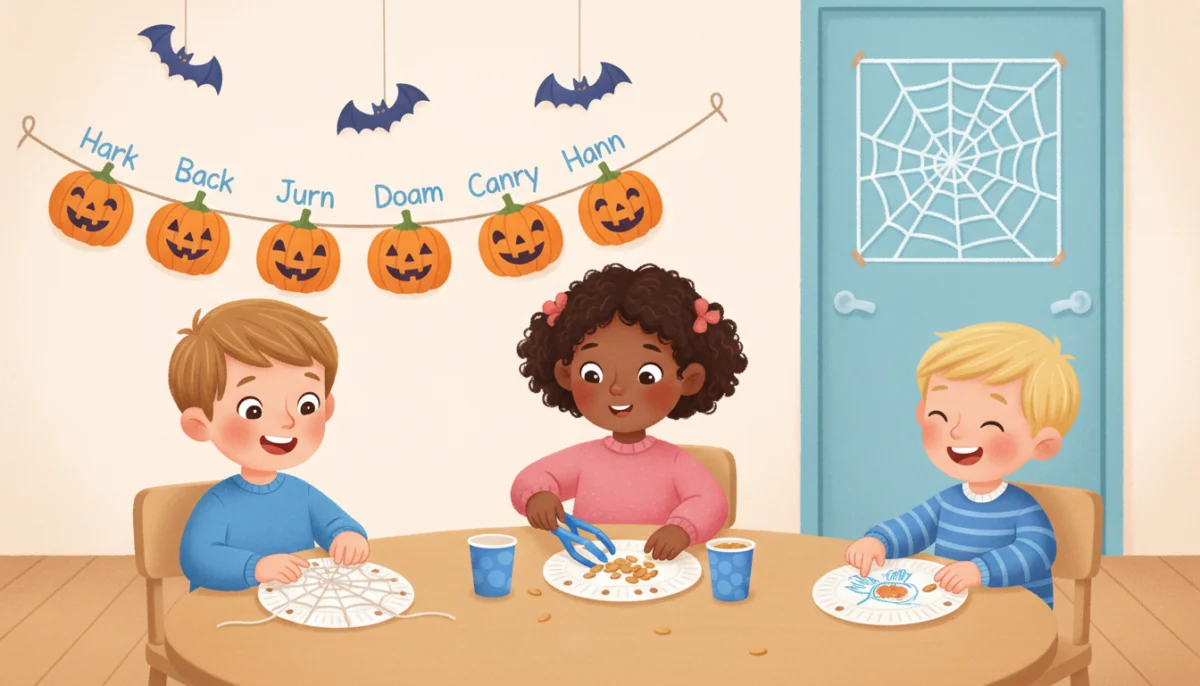
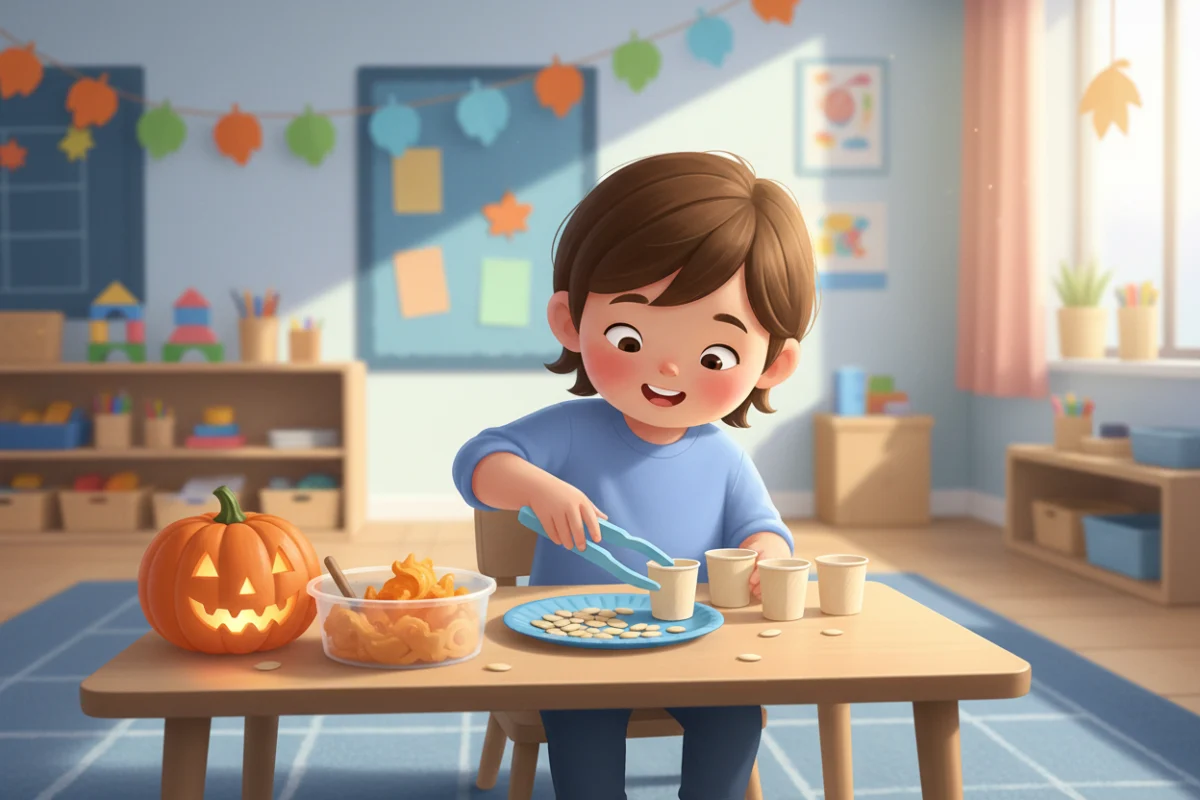
- Pumpkin seed sorting: real seeds, scooped from a class pumpkin, dried and sorted into cups with tweezers. Pinch practice, and a great follow-up to carving.
- Spider web weaving: a paper plate with slits cut around the edge, black yarn woven across. Both hands at work.
- Bat cutting practice: bat shapes with thick outlines to cut out, then hang from the ceiling. Curves and inside corners; see our guide to scissor skills by age for who can manage which shapes.
- Candy corn paper strips: cut yellow, orange and white strips and glue them in order to make candy corn. Straight-line cutting and sequencing.
- Monster hole-punch faces: children punch holes in a monster face shape for eyes and a mouth. Hand strength.
- Pumpkin play dough: orange play dough with green pipe cleaner stems and black beads for faces. Squeezing, rolling, pinching.
- Ghost tearing: white paper torn into ghost shapes and glued on black card with drawn faces. Pinch strength and no scissors, good for the youngest.
Math activities
- Pumpkin measuring: how many cubes tall? how many hands around? Record on a chart.
- Seed estimating: guess how many seeds are in the class pumpkin, then count in groups of ten.
- Spider leg counting: paper spiders with pipe cleaner legs; children add exactly eight, then compare with a six-legged bug.
- Candy corn patterns: orange, yellow, white in AB, ABC and ABB patterns with paper or real candy corn.
- Bat graph: a class graph of favorite Halloween creatures, with a picture card per child.
- Pumpkin sink or float: predict, test, record.
Literacy and language
- Halloween vocabulary cards for the writing center: pumpkin, spider, bat, owl, moon, leaf, cat.
- “In the dark, dark room” style pattern stories the class writes together, with a friendly ending.
- Spider letter web: a big web on the wall with letters at the ends of strands; children name the letter the spider lands on.
- Name pumpkins: each child writes their name on a paper pumpkin for the class patch. Our guide to teaching children to write their name explains the sequence.
Sensory and gross motor
- Pumpkin guts bin: the pulp and seeds from carving in a tub, with spoons and cups. Messy, and the most popular center of the month.
- Spider walk: crawl across the rug with bottoms up and hands flat, then bat-fly with arms out.
- Leaf and pumpkin sorting bin: dried leaves, mini pumpkins, acorns and pinecones with scoops and a magnifying glass.
Crafts that double as decorations
Any of the fine motor crafts above can go on the wall. A class pumpkin patch of name pumpkins, a ceiling of cut bats, a window of torn paper ghosts and a spider web on the door turn a month of practice into a room that families notice. Our fall paper crafts article has ten more that fit October, and paper chains in orange and black are the fastest decoration there is.
A four-week October plan
Week one: pumpkins. Bring in a class pumpkin, measure it, estimate the seeds, and open the pumpkin guts bin. Name pumpkins go up on the wall. Week two: spiders and webs. Web weaving at the fine motor center, spider leg counting in math, the spider letter web on the wall. Week three: bats and owls. Bat cutting practice, the bat graph, bats on the ceiling. Week four: party week. Candy corn patterns and strips, ghost tearing for the youngest, and the party on the last day.
Each week’s craft becomes the decoration for the next, so the room fills up gradually and there is no last-minute decorating. Everything comes down on the first day of November and makes way for leaves and turkeys.
Books to pair
Choose picture books about pumpkins, a friendly monster or a nervous ghost, a spider who spins, or a bat who is afraid of the dark. Your school librarian will have a stack. Read one a day at circle time and let it introduce the theme of the week. A book about a pumpkin’s life cycle links neatly to the pumpkin seed sorting and the sink-or-float test.
A calm party-day plan
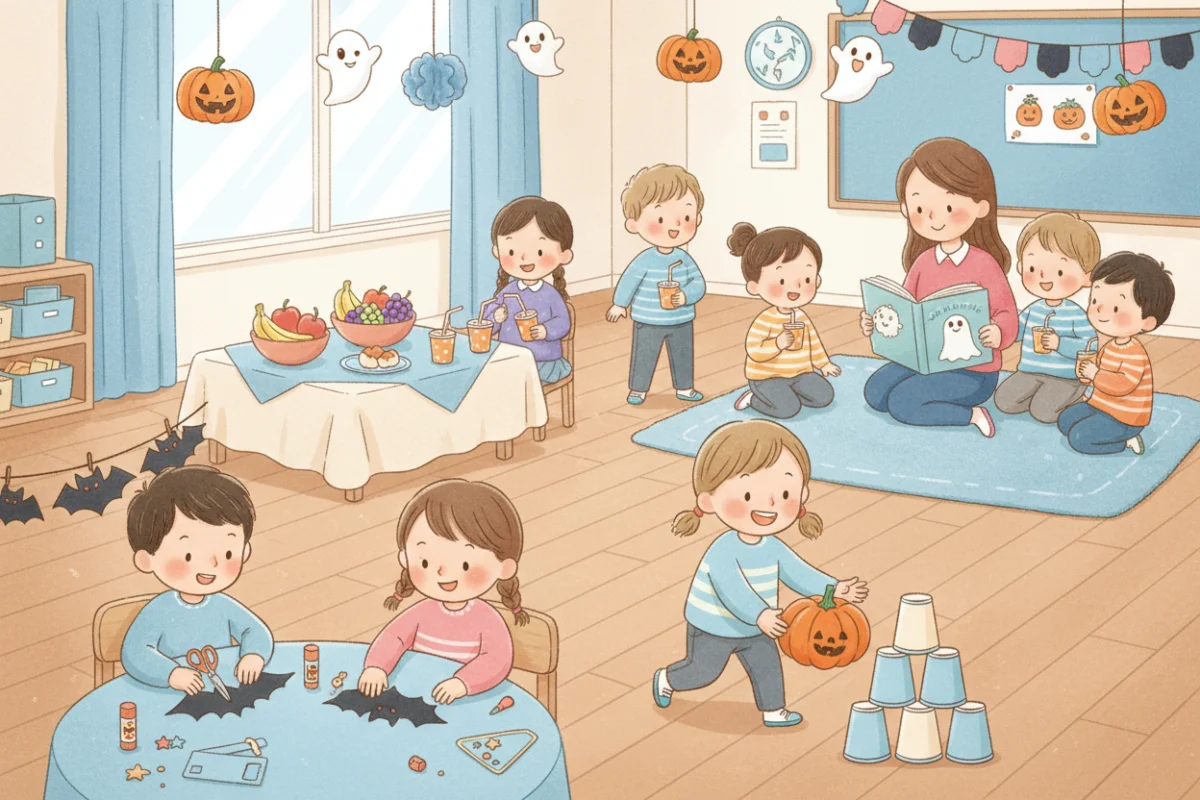
Keep the morning routine. Run the party as four centers of fifteen minutes each: a craft (bat or spider), a game (pumpkin bowling with a small pumpkin and paper cups, or “pin the stem on the pumpkin”), a snack table with fruit and one treat, and a story corner with a friendly Halloween book read by a parent volunteer. Rotate groups of five or six. Costumes, if you allow them, come out after the centers, for a short parade in the hallway, then go back in the bag. Send treats home in bags rather than eating them all at school.
For children who are anxious, assign them to the story corner first and let them skip the parade. For families who do not celebrate, offer a fall alternative in a quiet space, or frame the whole day as a “fall festival” with pumpkins and leaves, which many schools now prefer.
What to send home
A note the week before with the plan and any requests (a small pumpkin, a costume rule, a treat count). A link to our Halloween paper crafts to make at home for families who want to keep the crafting going.
Frequently asked questions
How do I do Halloween in a classroom where some families do not celebrate?
Focus on fall, pumpkins and creatures rather than ghosts and monsters, call the day a fall festival if that helps, and give families a clear note in advance with the option to opt out of any part.
What Halloween activities are good for fine motor skills?
Pumpkin seed sorting with tweezers, spider web weaving, bat cutting, candy corn strips, hole-punch monster faces and pumpkin play dough all build hand strength and scissor skills.
How do I keep a Halloween party calm in kindergarten?
Keep the normal routine, run the party as short rotating centers, limit sugar to one treat, and do costumes at the end for a short parade rather than all morning.
What are non-scary Halloween themes for preschool?
Pumpkins and the pumpkin patch, spiders and webs, bats and owls, black cats, candy corn, leaves, and friendly smiling ghosts.