Thanksgiving week is short, the children are tired, and the wall still needs a display before families come in. The good news is that Thanksgiving has a theme that works in every early childhood classroom regardless of background: gratitude. Build the week around what children are thankful for, add turkeys, leaves and harvest colors for the crafts, and you have a plan that is warm, quick and full of fine motor practice.
This guide gives you crafts sorted by skill, gratitude activities for different ages, a simple feast plan, and a short note on the history that avoids the old stereotypes.
Gratitude first
Start the week with a circle time question: what is something you are thankful for that is not a toy? The answers (my dog, my grandma, pancakes, recess) become the raw material for everything else. Write them on a chart and leave it up. Children who cannot yet write can draw their answer; children who can write add a word or a sentence.
Three gratitude activities that scale from pre-K to second grade:
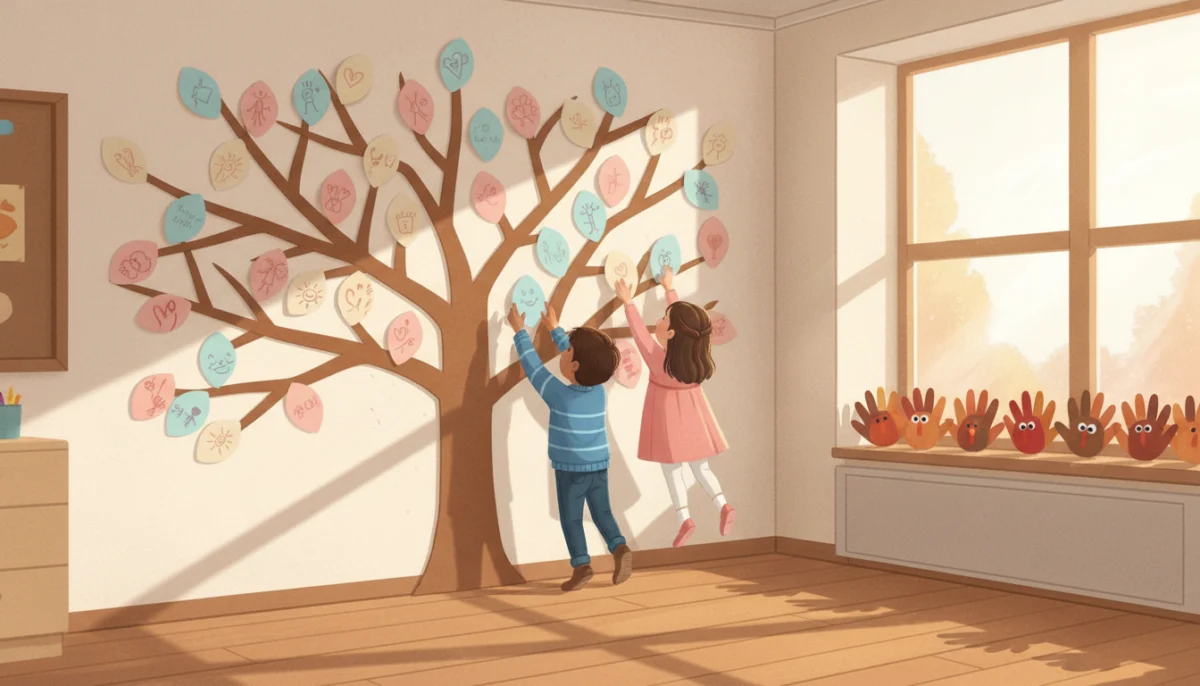
- Gratitude tree: a bare paper tree on the wall, and each child adds a leaf with their thankful thing. Cutting the leaf is fine motor practice; see our fall paper crafts for leaf ideas.
- Thankful book: a folded paper book with one page per day of the week. Draw or write one thing each day. Second graders add sentences; pre-K adds pictures and a dictated caption.
- Thank-you notes: children make a card for someone at school (the custodian, the librarian, the bus driver) and deliver it. It is the activity that adults remember.
Turkey crafts, done well
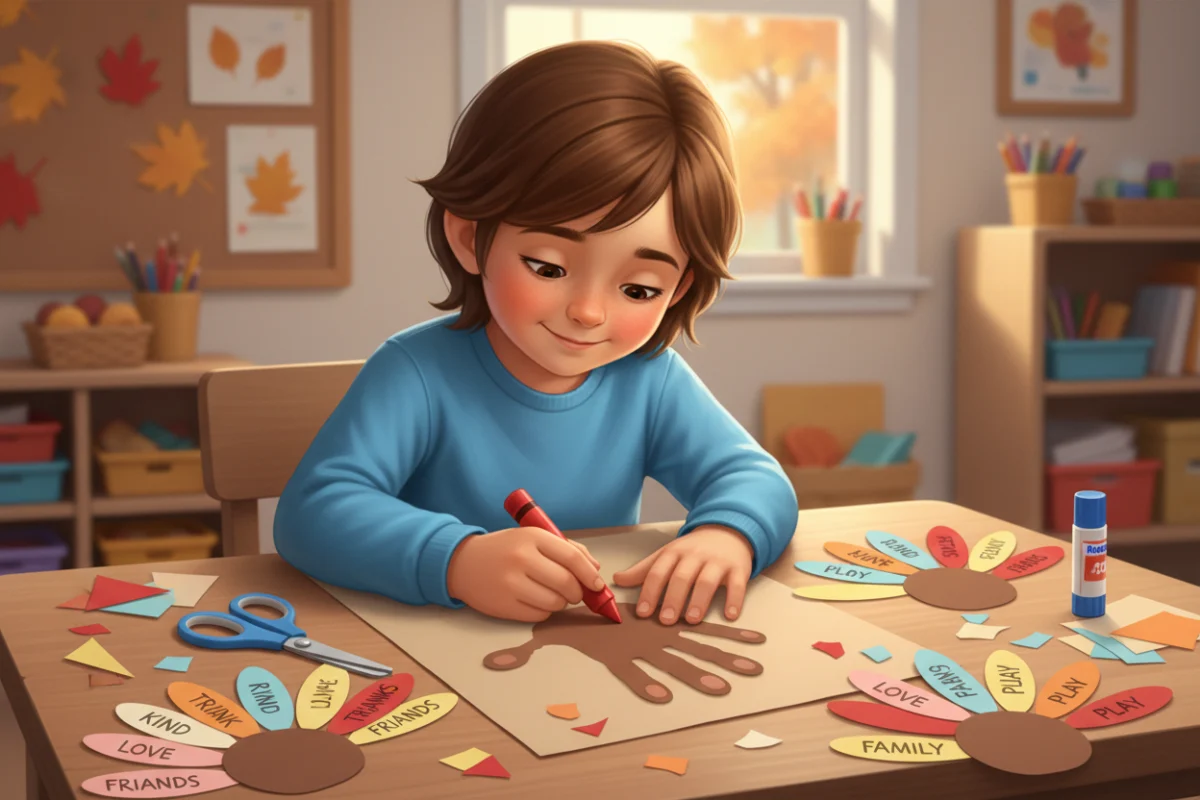
The handprint turkey is a classic for a reason: tracing the hand is fine motor practice and the result is personal. Make it better by having children trace their own hand (a wobbly outline is fine), cut it out themselves if they are able, and add the details with their own hands rather than pre-cut pieces.
- Handprint turkey: trace, cut, add a beak, wattle and legs from paper, and a feather on each finger with a thankful word.
- Paper strip turkey: a brown circle body with colored strips glued as a fan of feathers. Straight-line cutting and gluing.
- Fringed feather turkey: feathers cut from card and fringed along the edges with scissors. Snipping practice.
- Paper plate turkey: a plate body, accordion-folded paper feathers, a drawn face. Folding.
- Turkey in disguise: send a plain turkey outline home and ask families to disguise it so it will not be eaten. It comes back as a pirate, a princess, a pizza. Children present their turkey to the class.
Our guide to simple paper crafts explains how to run a craft as a center with easier and harder versions on the same table.
Harvest and leaf crafts
- Corn with fingerprint kernels: a corn cob outline, yellow and orange fingerprints, green paper husk. Pinch and press.
- Torn paper pumpkin pie: a paper “slice” filled with torn orange paper and a cotton ball of cream.
- Cornucopia collage: a paper horn with cut-out fruit and vegetables from grocery flyers glued in. Cutting around shapes.
- Leaf garland: leaf shapes in fall colors on yarn across the classroom. Our guide to paper chains and garlands has more.
- Place mats: woven paper mats for the feast, in fall colors. Bilateral coordination.
A four-day plan for Thanksgiving week
Most schools have a short week. Here is a plan that fits. Day one: the thankful question at circle time, the gratitude tree goes up, turkey-in-disguise goes home. Day two: turkey craft center (handprint for the youngest, paper strip or fringed feather for older children) and place mat weaving. Day three: harvest crafts and thank-you notes delivered around the school; turkey disguises come back and are presented. Day four: the feast, the thankful books go home, and the display comes down over the weekend.
If you only have three days, drop the harvest crafts. If you have five, add a leaf garland day and a read-aloud of a gratitude-themed picture book each morning.
Making crafts work for every child
Thanksgiving crafts often involve tracing and cutting around a hand, which is hard for some five-year-olds. Keep a pre-cut hand shape available for children who cannot manage it yet, and let them do the feathers and details. For children who are far ahead, the fringed feather turkey and the cornucopia collage add challenge. Our guide to scissor skills by age helps you see who needs which version, and our cutting station article explains how to keep scissor practice going between holidays.
A simple class feast
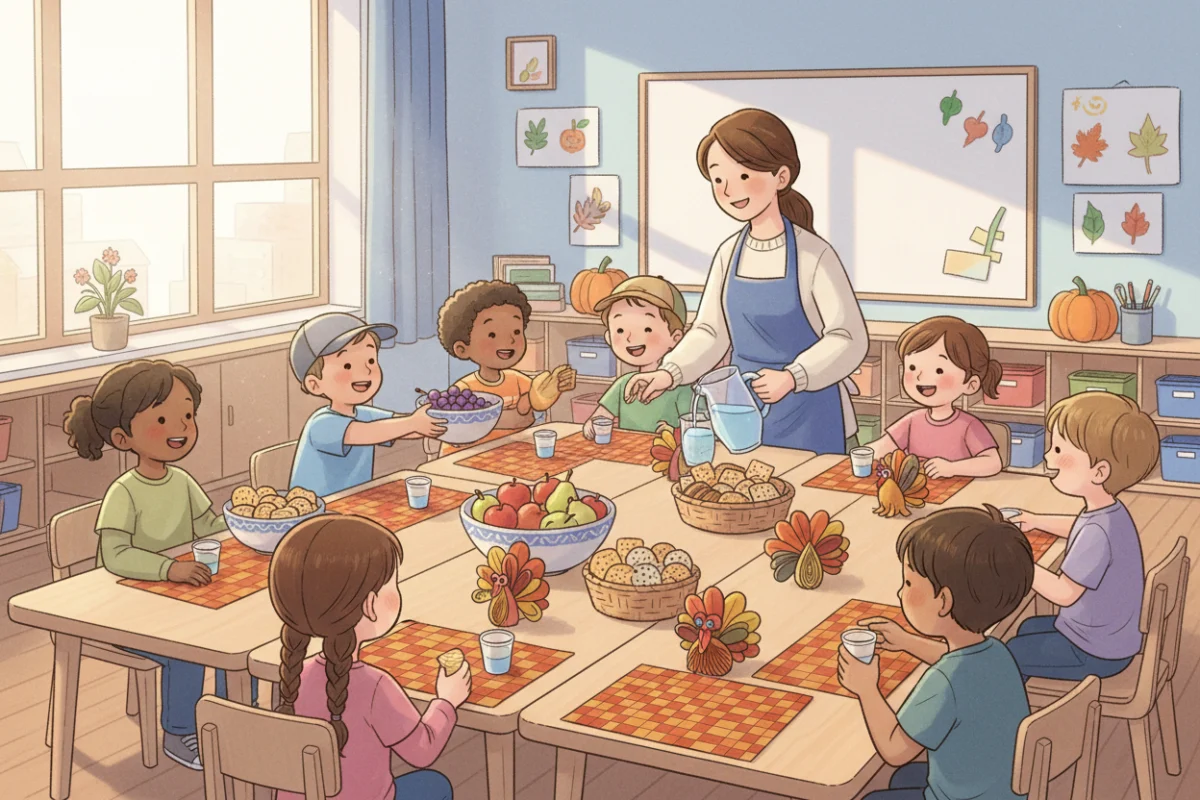
A feast does not need a turkey. Ask families for one simple item each (fruit, crackers, cheese, muffins, popcorn, juice), set the tables with the woven place mats and the paper strip turkeys as centerpieces, and have children serve each other. Before eating, go around the table and share one thankful thing. It takes thirty minutes, and the serving, pouring and passing are fine motor tasks in themselves.
For allergy safety, keep a list of what came from where, and label everything.
Talking about the history
Young children do not need the full story, but they should not get the old cartoon version either. A simple, honest approach for pre-K to second grade: Thanksgiving is a day when families gather to share food and say what they are thankful for. Long ago, people who came to this land shared a harvest meal with the Wampanoag people who already lived here. Today we remember that meal, and we also remember that Native people are still here, with their own traditions.
Avoid “Pilgrim and Indian” costumes, paper feather headdresses and generic “Indian” crafts, which many Native families find hurtful. Choose books by Native authors for the read-aloud if you can. If a child asks a hard question, “that is a good question and grown-ups are still learning about it too” is an honest answer.
Decorating without extra work
Everything above produces its own display. The gratitude tree fills the main wall, the turkeys line the windowsill or hang on the door, the leaf garland crosses the ceiling and the place mats set the feast tables. Add a paper banner with the word “Thankful” that children color one letter each, and the room is done by Wednesday with no extra prep. Photograph the wall before it comes down; families who missed the feast will want to see it.
Sending it home
Turkey-in-disguise goes home early in the week. Thankful books go home on the last day. Our list of Thanksgiving crafts for kids is a good link for families with a long weekend to fill.
Frequently asked questions
What are easy Thanksgiving crafts for preschoolers?
Handprint turkeys, fingerprint corn, torn paper pumpkin pie and gratitude tree leaves all work for three- and four-year-olds with minimal cutting.
How do I teach gratitude in kindergarten?
Ask a daily “thankful for” question, make a class gratitude tree, write thank-you notes to school staff, and share one thankful thing before the class feast.
How do I handle Thanksgiving history with young children?
Keep it simple and honest: a shared harvest meal long ago, gratitude today, and respect for the Native people who were here first and are still here. Avoid costume stereotypes.
What is the turkey in disguise project?
A plain turkey outline goes home and families disguise it as something else so it will not be eaten. Children present their disguised turkey to the class.