December is the month when a classroom’s differences show. Some children are counting down to Christmas, some are lighting Hanukkah candles, some celebrate Kwanzaa, Diwali came a few weeks ago, and some families do not mark any holiday at all. A teacher who fills the room with one holiday leaves some children out. A teacher who avoids the season entirely leaves the excitement on the table.
The middle path is to build December around three ideas that almost every winter tradition shares: snow and cold, light in the dark, and giving. Here are crafts for each, a way to include specific holidays respectfully, and a December plan that keeps the fine motor practice going through the busiest month of the year.
Snow and cold
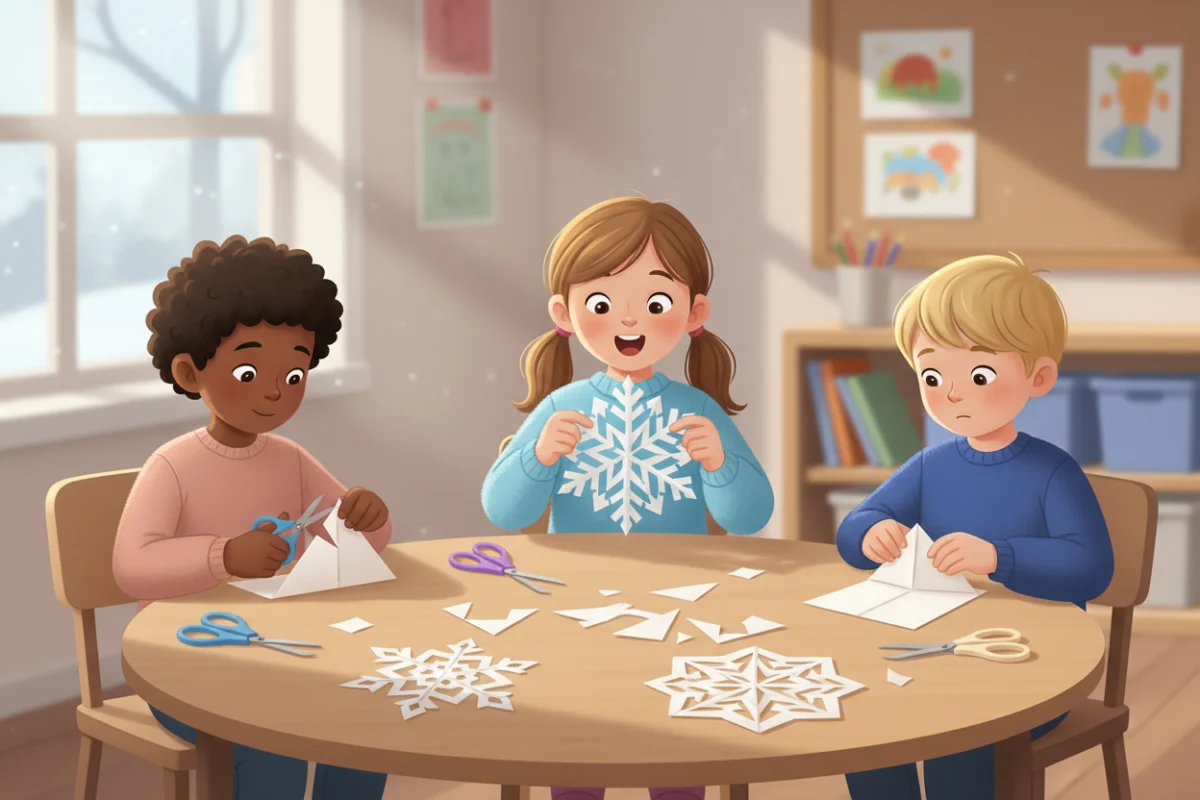
Snow needs no holiday. It works in classrooms in Florida as well as Minnesota, and the crafts are some of the best cutting and folding practice of the year.
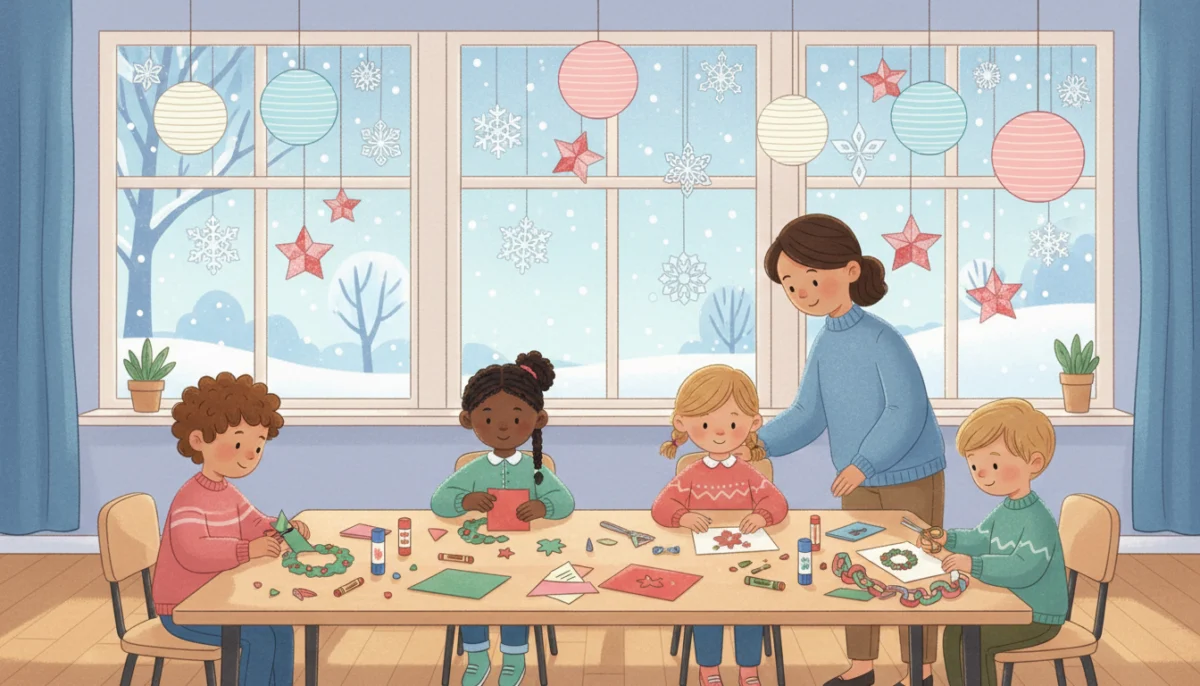
- Cut paper snowflakes: fold a square twice, then diagonally, and cut notches. The youngest fold twice only; older children fold three or four times and cut small shapes. Our guide to simple paper crafts has the details.
- Torn paper snowman: white paper torn into pieces and glued into three circles, with a paper hat and scarf. No scissors, ideal for pre-K.
- Mitten pairs: children cut two mittens from patterned paper and decorate them to match. Symmetry and cutting curves.
- Snow globe: a paper circle “globe” with a cut-out scene inside, glued to a base, and glitter or salt for snow.
- Cotton ball polar bear: a bear outline filled with cotton balls, pinched and glued one by one. Pinch strength.
- Penguin from a paper cup or tube: black and white paper, an orange beak, and flipper wings that fold out.
- Ice paint: watercolor on paper, then a sprinkle of salt while wet, for a frost effect. Not a fine motor craft, but children love it.
Light in the dark
Candles, lanterns, stars and lights appear in Christmas, Hanukkah, Kwanzaa, Diwali, Lucia, solstice celebrations and more. A “light” theme lets you honor all of them.
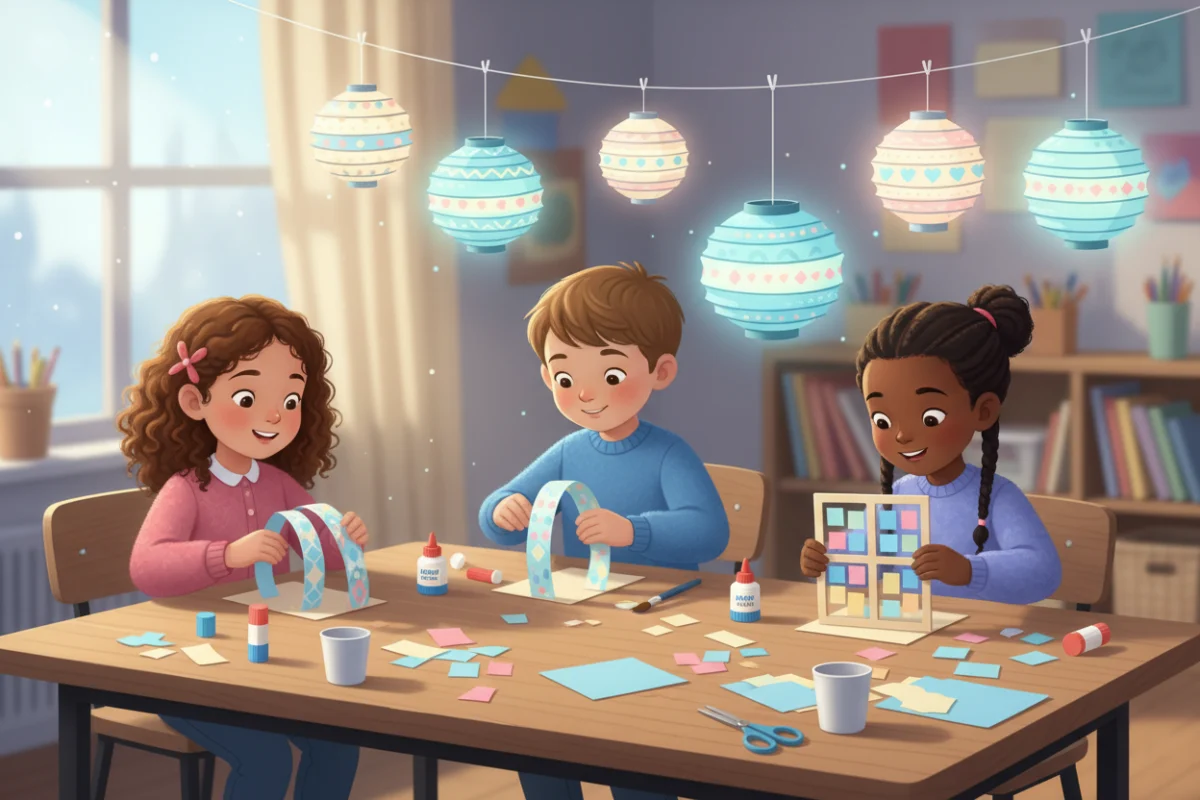
- Paper lanterns: fold a sheet in half, cut slits from the fold, open and curl into a cylinder, add a handle. Cutting on a line and curling.
- Tissue paper stained glass: a paper frame with tissue squares glued inside, hung in the window. Pinching and placing small pieces.
- Candle collage: children cut a candle and a flame and add “light rays” with torn yellow paper. Talk about the candles in different traditions.
- Star garland: stars cut from card and strung across the room. See our paper chains and garlands article for stringing tips.
- Foil star rubbing: a cardboard star under foil, rubbed with a crayon.
Giving
Making a gift for someone teaches generosity, and gift-making is full of fine motor work. Choose gifts children can make almost entirely themselves.
- Handmade cards: folded card, cut shapes, a written message. The message is handwriting practice with a real purpose; our guide to name writing explains why signing matters.
- Salt dough ornaments or paperweights: roll, cut with a cookie cutter, poke a hole, bake, paint. Every step is hands.
- Woven paper bookmarks: narrow woven mats laminated with clear tape.
- Decorated paper gift bags: a plain bag with stamped, drawn or collaged decorations to carry the gift home.
- Handprint keepsakes: a handprint in paint on card with the date, for families. Simple and always kept.
- Fringed paper wreaths: a paper ring with fringed green strips glued around it and a bow, which suits any tradition or none.
Managing December energy
The crafts are only half the challenge in December; the other half is the mood. Children are tired, overstimulated and counting down. A few habits help. Keep the daily routine exactly the same, with holiday content slotted into the usual blocks rather than replacing them. Do crafts in the morning, when attention is best, and save read-alouds and calm activities for the afternoon. Keep a “quiet corner” with winter books and a snow sensory bin (cotton balls, white pom-poms, scoops) for children who need to step out of the noise. And give a five-minute warm-up before craft time; our handwriting warm-ups settle hands and bodies before scissors come out.
A countdown paper chain, one loop removed each morning, gives the class a shared, visible sense of time that reduces the “how many days” questions.
What to keep for your portfolio
December produces a lot of paper. Keep one snowflake, one gift card and one piece of writing per child for the portfolio, photograph the wall displays, and let the rest go home in the decorated gift bags. Families get a bag full of their child’s work, and you get a clean room for January.
Including specific holidays respectfully
A “light and giving” theme does not mean pretending holidays do not exist. Invite families to share how they celebrate, through a short visit, a photo, or a note you read aloud. Read picture books about several traditions across the month. If you make a craft tied to one holiday, make one for another the same week. And do not assign a holiday to a child; let them tell you.
Some schools ask teachers to keep religious symbols out of crafts. If that applies, the snow and light themes carry December on their own.
A December plan
Week one: snow. Snowflakes go up in the windows, the torn paper snowman at the fine motor center, mittens for the youngest. Week two: light. Lanterns and stained glass, the candle collage with a conversation about traditions, the star garland across the room. Week three: giving. Gift-making across the week, cards on the last day, gift bags to carry everything home. If there is a fourth week, a “winter party” with the same calm-centers structure as our Halloween party plan works well.
Keep the cutting station open all month with white and blue strips. December is when many children’s scissor skills leap forward, because they are cutting every day.
Adapting for ages
In pre-K, favor tearing, pinching and gluing: the torn snowman, the polar bear, the stained glass and the wreath. In kindergarten, add folding and cutting: snowflakes with two folds, lanterns and mitten pairs. In first and second grade, snowflakes with four folds, the snow globe with a cut-out scene, woven bookmarks and cards with a full written message. Offering two versions of each craft on the same table, as our scissor skills guide suggests, lets a mixed-age or mixed-ability room work on the same theme together.
For families
Send home our Christmas paper crafts for kids for families who celebrate, and the snow and light crafts above for those who do not. Both keep the fine motor practice going through the break.
Frequently asked questions
How do I do holiday crafts in a classroom with different religions?
Build the month around snow, light and giving, which most winter traditions share, invite families to share their own celebrations, and avoid assigning a holiday to any child.
What are good winter crafts for preschoolers?
Torn paper snowmen, cotton ball polar bears, fringed wreaths and tissue paper stained glass need little cutting and work well for three- and four-year-olds.
What winter crafts build fine motor skills?
Cut paper snowflakes (folding and cutting through layers), paper lanterns (cutting on a line), woven bookmarks (bilateral coordination) and salt dough ornaments (rolling and pressing).
What gifts can kindergarteners make for their families?
Handmade cards with a written message, salt dough ornaments, woven bookmarks and handprint keepsakes can all be made almost entirely by the child.